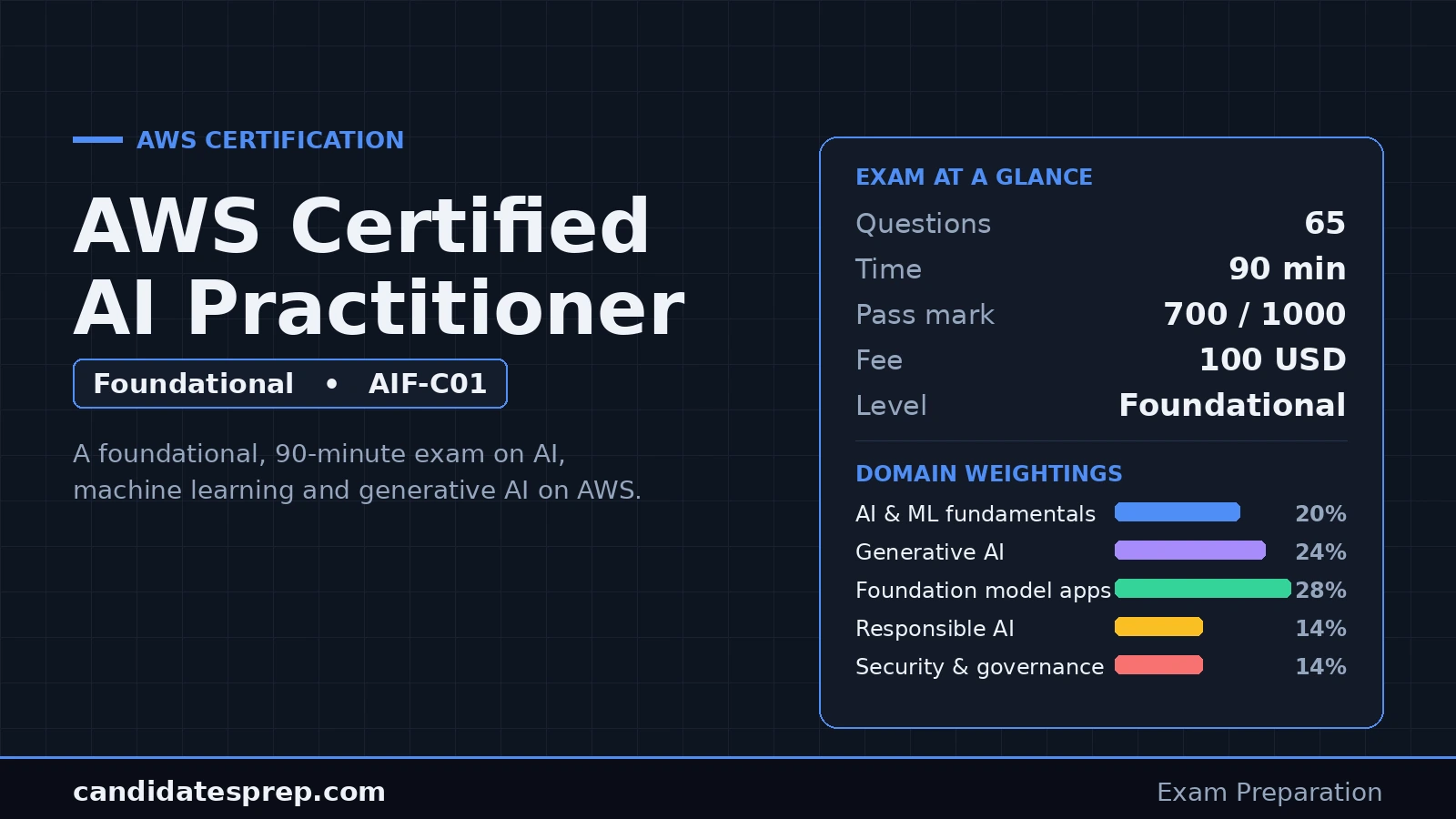
The AWS Certified AI Practitioner (AIF-C01) is a foundational exam that checks whether you understand AI, machine learning and generative AI on AWS, without needing to build the systems yourself. You get 65 questions in 90 minutes, and you need a scaled score of 700 out of 1000 to pass.
What the exam covers
The exam sits at foundational level, so it rewards clear understanding rather than hands-on engineering. AWS sets 65 questions with a 90-minute time limit, and the fee is 100 USD. Of those 65 questions, 50 are scored and 15 are unscored trial questions that AWS uses to shape future exams, so treat every question as if it counts. The pass mark is a scaled score of 700 on a range of 100 to 1000, and scoring is compensatory, which means a strong domain can offset a weaker one and you do not need to pass each section separately.
Five content domains make up the exam, and the weightings tell you where your revision time is best spent:
- Fundamentals of AI and ML: 20 per cent
- Fundamentals of generative AI: 24 per cent
- Applications of foundation models: 28 per cent
- Guidelines for responsible AI: 14 per cent
- Security, compliance and governance for AI solutions: 14 per cent
Applications of foundation models is the largest single domain, and generative AI fundamentals is close behind, so more than half of the exam turns on modern generative AI and how you apply it on AWS. You can confirm every figure on the official AWS exam guide.
Know the four question formats
AWS uses more than plain multiple choice here, so read each question stem carefully. You will meet four formats:
- Multiple choice: one correct answer and three distractors.
- Multiple response: two or more correct answers from five or more options, and you must select them all.
- Ordering: arrange three to five steps into the correct sequence.
- Matching: pair three to seven prompts with the right responses.
The multiple-response, ordering and matching items are unforgiving, because a partly correct answer scores nothing. Practise those formats deliberately rather than defaulting to standard multiple choice.
Where to focus your preparation
Because the generative AI and foundation model domains carry the most weight, build real fluency there. Make sure you can explain, in plain language:
- The difference between AI, machine learning and deep learning, and where generative AI fits.
- What a foundation model is, and the role of services such as Amazon Bedrock and Amazon SageMaker at a conceptual level.
- Prompt engineering basics, and why an approach like retrieval augmented generation improves accuracy.
- Responsible AI ideas: bias, fairness, transparency and explainability.
- Security and governance for AI workloads, including data protection and the shared responsibility model.
You are not asked to write code or train models. You are asked to choose a sensible AWS approach for a described business problem and to reason about cost, risk and responsible use.
Practise under real exam conditions
Reading about the format is not the same as sitting it. The surest way to expose your weak domains is to answer timed questions that behave like the real exam. On CandidatesPrep you can take a mock that runs to the clock, draws from a randomised question bank so you learn the concepts rather than the order, and scores you by section so you can see whether it is responsible AI or foundation models holding you back. Trainers running a cohort can enrol candidates in bulk and see at a glance who is ready and who needs another sitting.
Exam-day tactics
- Answer the straightforward questions first, flag the rest, and come back with your spare time.
- On multiple-response items, judge each option on its own merits before you commit.
- Be wary of absolute words such as always and never, which often mark a wrong option.
- Never leave a question blank, because there is no negative marking and a considered guess can only help.
- Watch the clock: 90 minutes across 65 questions gives you a little over a minute each.
The bottom line
The AWS Certified AI Practitioner is an accessible, foundational route into cloud AI, and it is very winnable if you concentrate on the generative AI and foundation model domains that carry the most weight. Learn the four question formats, revise responsible AI and governance, and rehearse under time. Always confirm the current details on the official AWS exam guide before you book, because AWS refreshes its certifications from time to time.
Ready to test yourself? Try a timed, section-scored mock on the CandidatesPrep simulator, and if you train others, book a demo to see cohort tracking in action. For related reading, see what an exam simulator is and how online proctoring works.