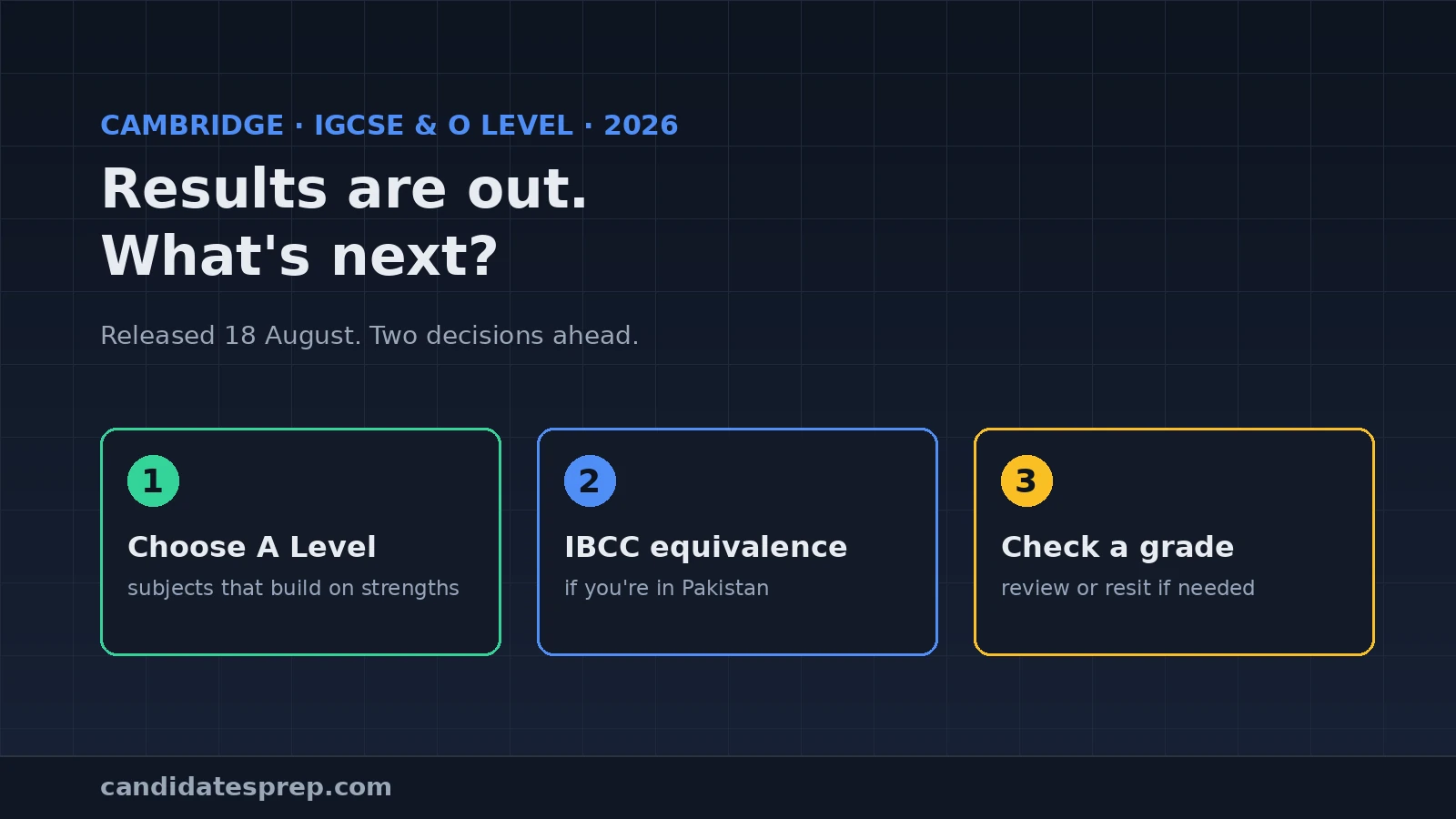
Cambridge IGCSE and O Level results were released yesterday, 18 August 2026, at 06:00 GMT/UTC. If you have your grades in hand, the natural next question is "what now?" For most students, two decisions follow quickly: which subjects to take at A Level, and, if you are in Pakistan, getting your IBCC equivalence sorted. Here is a calm walk through both, plus what to do if a grade looks wrong.
How you received your results
You do not get results directly from Cambridge. They are released to your school or exam centre, which issues them to candidates. If you registered as a private candidate, they come through your centre. Before anything else, check that every subject you sat appears and that the grades match the subjects, because errors, while rare, are easiest to spot now.
Next step one: choosing your A Level subjects
Your IGCSE and O Level results are the best evidence you have for what to take next.
- Play to demonstrated strength. Subjects where you scored well are usually where you will cope with the step up in difficulty at A Level. A strong grade signals both aptitude and, often, enjoyment.
- Keep future doors open. Many university courses require specific A Level subjects. If you are even considering medicine, engineering or economics, check the typical subject requirements before you lock in choices, because some are hard to add later.
- Be honest about the jump. A Level is a significant step up from IGCSE. Three subjects done well generally serve you better than four stretched thin.
If a required subject came in weaker than you hoped, that is worth a conversation with your school before deciding, rather than a snap choice on results day.
Next step two: IBCC equivalence, if you are in Pakistan
In Pakistan, many admissions and processes ask for an IBCC equivalence certificate, which converts your Cambridge grades into a Pakistani marks equivalent. On IBCC's official conversion tables, from the 2021 session onwards, the top grade *A\ is treated as "above 90"**, and IBCC publishes subject-wise equivalent marks per examination session, so always use the table that matches your exact session rather than a figure from a blog. We covered the full process, and where to confirm the current documents and fee, in our guide to IBCC equivalence.
The timing point matters: equivalence takes processing time, so if you will need it for admissions, start the application promptly rather than leaving it until a deadline is close.
If a grade looks wrong
If a grade genuinely does not match your expectation, Cambridge has a formal review process, requested through your exam centre. One thing to understand before you ask: a review of marking can move a grade up, leave it unchanged, or move it down. So use it when you have a real reason, not simply out of disappointment, and talk to your subject teacher first. We explained how this works, and the deadlines, in our Cambridge results day guide.
If you want to improve a grade
You can resit a subject in a later Cambridge series, and resitting does not cancel your existing certificate, so you keep your better result. If a resit is on the cards, decide early, because the most effective preparation is spread over time, not crammed the week before.
Prepare smart for A Level or a resit
Whether you are stepping up to A Level or planning a resit, the same principle applies: practise under real exam conditions. Full, timed papers show you where your marks are actually lost, so your revision targets the right topics rather than the ones you already know. CandidatesPrep's simulator lets you sit timed mocks scored by topic, turning a vague sense of "I need to do better" into a specific plan, and it lets schools track a whole cohort's readiness for the next series.
The bottom line
Cambridge IGCSE and O Level results landed on 18 August. Read them carefully, choose A Level subjects that build on your strengths while keeping your university options open, and, in Pakistan, begin your IBCC equivalence early if you will need it. If a grade looks wrong, the review route exists but can move a grade either way, and a resit is always possible without losing what you have earned. Take the next step deliberately, not in results-day panic.
Moving up to A Level, or planning a resit? Practise under timed exam conditions, or book a demo to see how schools track readiness on CandidatesPrep.