Plenty of IELTS candidates get a surprise when their overall band does not match the average they did in their head. The calculation is simple, but it has a rounding rule that can push your score up, and understanding it can change how you spend your last weeks of preparation. Here is exactly how the IELTS overall band score is worked out, straight from the official rules, with worked examples.
The scale, and the four sections
IELTS uses a nine-band scale, and "scores are reported in whole and half bands", so 6.5 and 7.0 are possible but 6.7 is not. You receive a band score for each of the four sections, Listening, Reading, Writing and Speaking, and then an overall band score on your results.
The formula
The rule is short: "The overall band score is the average of the four section band scores rounded to the nearest half band." So you add your four section scores, divide by four, and round the result to the nearest half band.
The rounding is where people trip up, and IELTS states it precisely: "If the average of the four sections ends in .25, the overall band score is rounded up to the next half band, and if it ends in .75, the overall band score is rounded up to the next whole band."
Worked examples
These are the official examples, and they show the rule in action.
- Average 6.25 rounds up to 6.5. A candidate who averages 6.25 across the four sections is rounded up to an overall 6.5.
- Average 3.875 rounds to 4.0. An average of 3.875 rounds to the nearest half band, giving 4.0.
- Average 6.125 rounds to 6.0. An average of 6.125 is closer to 6.0 than to 6.5, so it rounds down to 6.0.
Notice the asymmetry: a .25 average is rounded up, but a .125 average rounds to the nearer half band as normal. That single rule is why two candidates with very similar raw performance can end up half a band apart.
Why this matters for your strategy
The rounding rule turns your weakest section into your biggest opportunity. Because the overall band is an average, lifting one section by half a band can be exactly what tips your average across a rounding threshold.
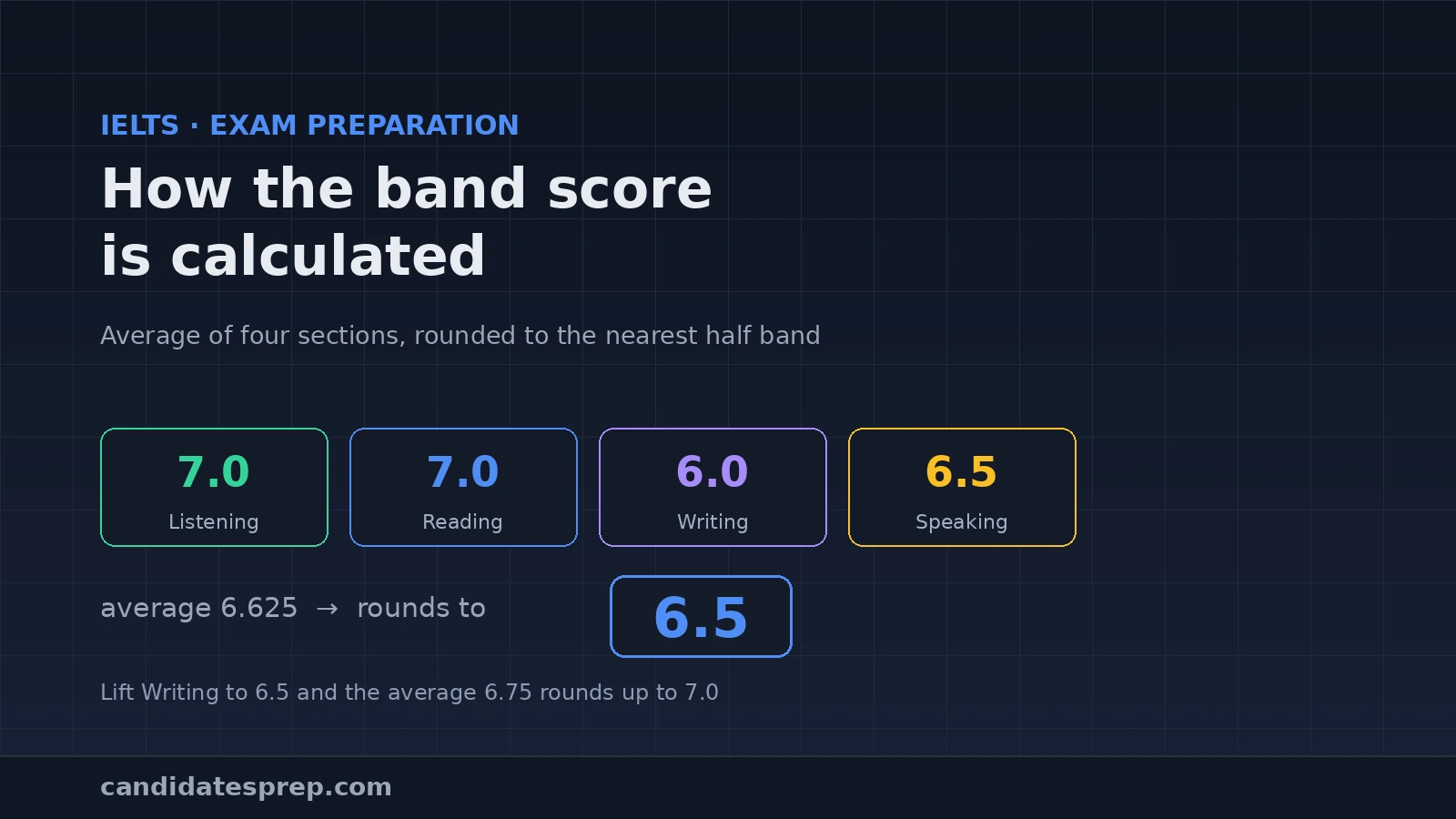
- Find your section nearest a boundary. If your practice scores sit at, say, Listening 7, Reading 7, Speaking 6.5 and Writing 6, your average is 6.625, which rounds to 6.5. Pulling Writing up to 6.5 would lift the average to 6.75, which rounds up to a 7.0. One section moved the whole result.
- Do not chase your strongest skill. Adding marks to a section you are already strong in rarely changes the rounding. The leverage is in your weakest section.
This is why targeted practice beats general study near the end. Knowing which single section to lift, and by how much, is often the difference between the band you have and the band you need.
Common misunderstandings
- A brilliant Speaking cannot rescue three weak sections. Because all four are averaged equally, one strong section only pulls the average so far.
- The overall band is not the only thing that matters. Many universities and immigration authorities require a minimum in each section, not just an overall band. You can hit the overall requirement and still fall short if one section is below the required minimum, so always check both.
- Half bands are real bands. A 6.5 is a distinct, widely accepted result. Do not assume you must reach the next whole band unless your target specifically requires it.
Practise with section-level scoring
The rounding rule only helps you if you know your current section scores, which is where realistic, section-scored practice earns its keep. Full, timed mocks that report each of the four sections separately show you exactly which one is closest to a boundary, so your final weeks target the section that will actually move your overall band. CandidatesPrep's simulator scores practice by section under timed conditions, and teachers preparing IELTS groups can see, per student, which skill is holding each band back.
The bottom line
Your IELTS overall band is the average of your four section scores, rounded to the nearest half band, with .25 rounding up to the next half and .75 up to the next whole band. The practical lesson is not the arithmetic but the strategy it reveals: your weakest section, not your strongest, is where a half-band gain can lift your whole result. Find that section, target it, and make the rounding rule work for you.
Aiming for a specific band? Practise under timed conditions with section-level scoring, or book a demo to see how teachers track IELTS readiness on CandidatesPrep.