Booking the wrong IELTS test is one of the most expensive mistakes a candidate can make, because it usually means paying for and sitting the whole test again. The two types, Academic and General Training, share the same Listening and Speaking sections but differ in Reading and Writing, and which one you need depends entirely on why you are taking IELTS. Here is how to choose correctly the first time.
The short answer
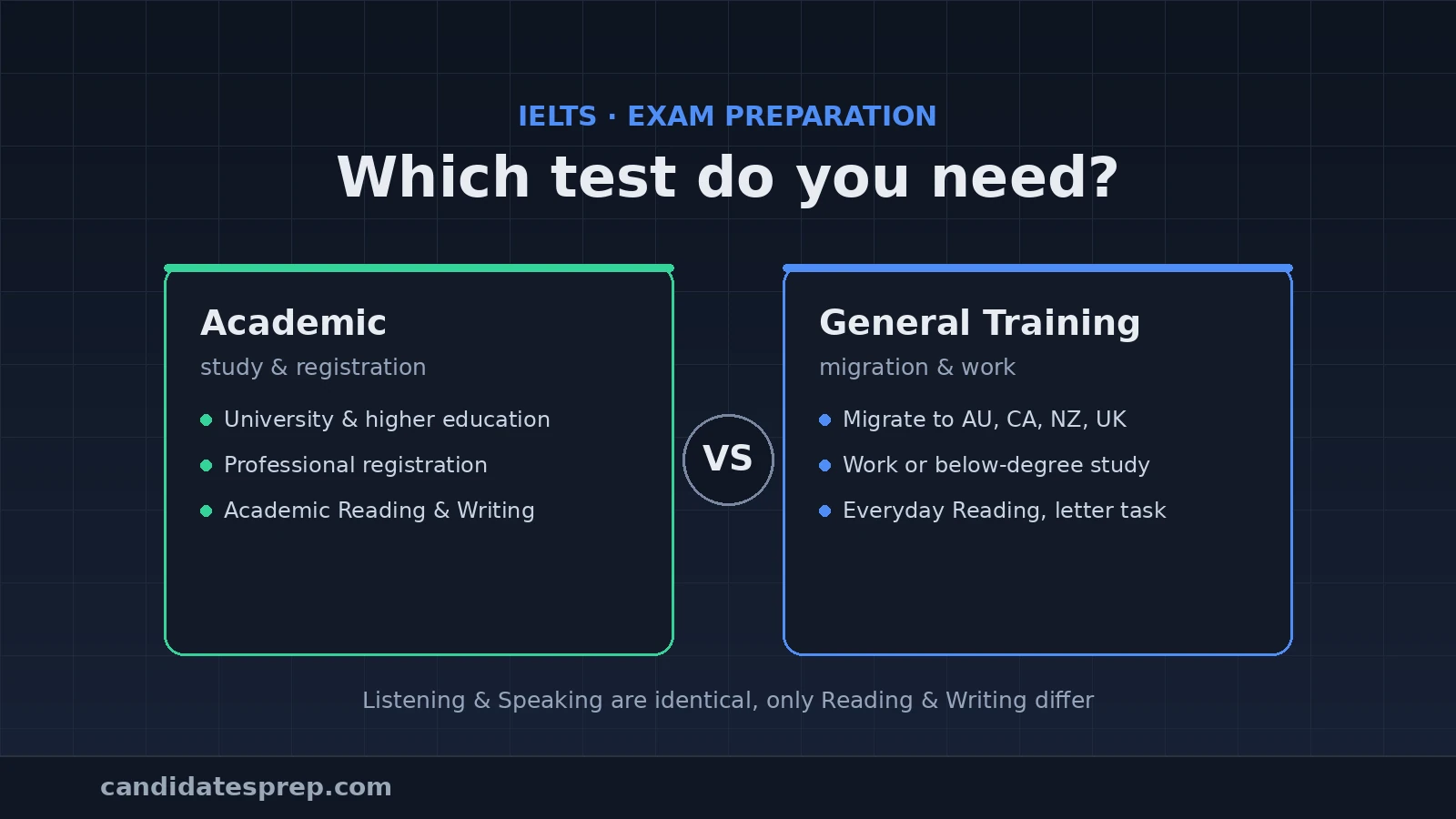
- IELTS Academic is for higher education and professional registration. As IELTS puts it, if you are "planning to study in a country where English is spoken, it's likely that the IELTS Academic test is the right choice", and it is also used "for professional registration purposes".
- IELTS General Training is for migration and below-degree study or work. It is "suitable for those wishing to migrate to a country where English is spoken (Australia, Canada, New Zealand, UK), and for those wishing to train or study at below degree level".
If you are heading to university or seeking professional registration, that points to Academic. If you are migrating, or studying or working below degree level, that points to General Training. But the final word always belongs to the organisation asking for your score, which we will come back to.
What is the same, and what differs
Both tests cover the same four skills: Listening, Reading, Writing and Speaking, and IELTS is reported on a nine-band scale from 0 to 9.
The key fact is what carries across and what does not. In IELTS's own words, "in both the General Training and the Academic tests, the Speaking and Listening sections are the same", while "the Reading and Writing sections of these tests differ. They have been designed to assess language ability that is more relevant for each specific sector."
In practice, that difference looks like this:
- Reading. Academic uses longer, more formal passages of the kind you meet in academic study. General Training uses everyday and workplace texts, such as notices, adverts and staff handbooks.
- Writing Task 1. Academic asks you to describe visual information, such as a graph, table, chart or diagram. General Training asks you to write a letter in response to a situation.
- Writing Task 2. Both types ask for an essay, and this task is broadly similar across the two.
Because Listening and Speaking are identical, general preparation for those two skills serves you whichever test you take. Your Reading and Writing practice, however, must match your test type, and this is exactly where candidates who prepared for the wrong version lose marks.
How to choose, properly
The rule of thumb above is a starting point, not the decision. The organisation you are submitting your score to, a university, a professional body, an employer, or an immigration authority, specifies both the test type and the minimum band it requires. Confirm those two things at the source before you book.
- Higher education or professional registration: usually Academic, but check the specific programme or registration body, because requirements vary.
- Migration to Australia, Canada, New Zealand or the UK: often General Training, but not always, as some skilled and professional routes require Academic.
- UK visas: IELTS is "accepted by the UK Visas and Immigration (UKVI) as proof of English proficiency for those wishing to live, work, or study in the UK." UK visa routes can require a specific IELTS for UKVI version, so check your exact visa's requirement rather than assuming.
The single most reliable step is to read the requirement in writing from the body that will receive your score, and match your booking to it exactly.
The mistakes that cost a retake
- Booking General Training for a university that wants Academic. Common among applicants who assume "I am going abroad, so General Training".
- Assuming migration always means General Training. Some professional and skilled-migration routes require Academic.
- Ignoring the minimum band. Passing the right test type but missing the required band per skill is still a fail for your purpose. Know the exact bands you need before you start.
For the exact current test length and section timings, confirm them on the official IELTS test format page rather than relying on a remembered figure, since these are the details worth getting from the source.
Practise the right version, under real conditions
Once you know which test you need, your Reading and Writing practice must match it, and timing is where many candidates come unstuck. Full, timed practice in the correct format, Academic or General Training, builds the pacing that separates a target band from a near miss, and it stops you from preparing for the wrong Task 1 entirely. CandidatesPrep's simulator lets you sit timed practice and see where your marks are slipping by section, so your revision targets the skills holding your band back. Teachers preparing IELTS groups can track readiness across a whole class.
The bottom line
IELTS Academic and General Training share Listening and Speaking but differ in Reading and Writing, and the right choice follows your purpose: Academic for higher education and professional registration, General Training for migration and below-degree study or work. Do not decide from a rule of thumb alone, though. Confirm the exact test type and minimum band with the organisation receiving your score, then prepare in that version, and you will only ever sit IELTS once.
Preparing for IELTS, or teaching a class? Practise under timed conditions in the right test format, or book a demo to see how teachers track IELTS readiness on CandidatesPrep.