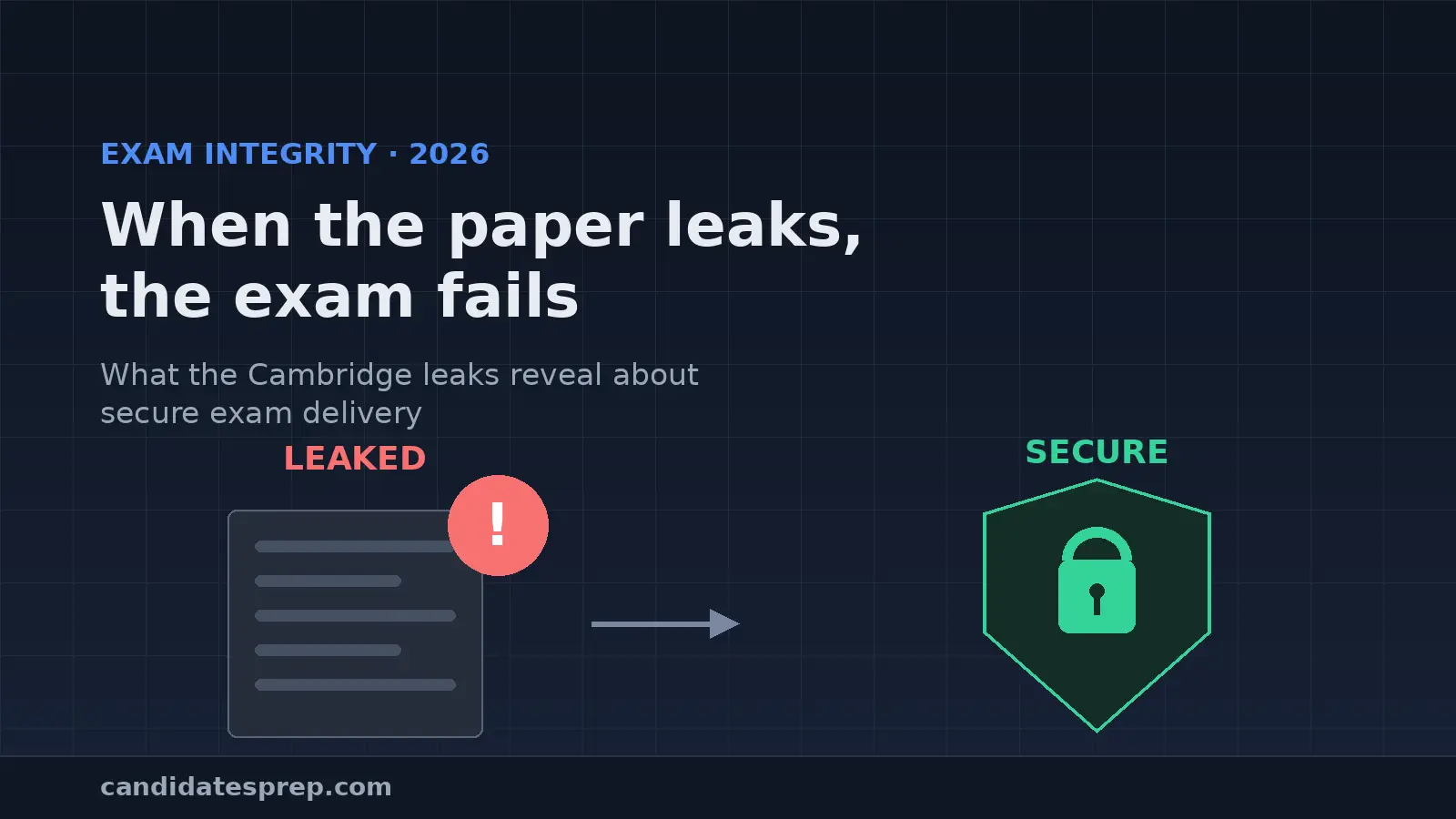
In the May/June 2026 series, Cambridge International Education cancelled an AS Level Mathematics paper in Pakistan after it circulated online before candidates sat it. What followed was rare: a mid-session cancellation, a free resit, a federal cybercrime probe, and parliamentary scrutiny. For students it was frightening. For everyone who runs exams, it is a clear lesson in how paper-based assessment fails, and how digital delivery can close the gap. Here is what happened, verified against news reporting, and what it means.
What actually happened
The paper at the centre of the incident was AS Level Mathematics Paper 12 (9709/12), sat on 29 April. Solved versions appeared on social platforms around exam time. After reviewing the breach, Cambridge concluded, in its own words, that "the extent of the sharing means we cannot use this paper to award final examination results," and cancelled it. A second Mathematics paper scheduled for that week was postponed as a precaution. News reports put the number of affected candidates at around 25,000, though Cambridge did not publish an official figure.
Cambridge organized a replacement examination on 9 June 2026, covering the affected administrative zones, and confirmed there would be "no additional cost for students or schools." Crucially, it also held its ground on timing: the results release date of 11 August 2026 would remain unchanged, protecting university admission timelines at home and abroad.
The official response
This was not handled quietly. Pakistan's Interior Secretary, Muhammad Khurram Agha, directed the National Cyber Crime Investigation Agency (NCCIA) to investigate the leaks in coordination with Cambridge, tracing how the papers were taken and shared. The National Assembly's education subcommittee also took up the matter, and public pressure from parents and educators helped secure the free-resit outcome. The combination of a regulator's cybercrime unit and a parliamentary committee engaging with a foreign exam board at this level is unusual, and it signals how seriously repeated leaks are now being treated.
What it means for affected students
If you sat the cancelled paper, the important points are straightforward. Your results timeline was preserved: grades still land on 11 August. The resit carried no fee. And if you have concerns once results are out, you retain the normal routes of recourse. Schools and private candidates can file an Enquiry on Results through their exam centre for a re-mark or review. Separately, if you choose to resit in a later series such as November, Cambridge's own guidance is that doing so does not cancel your existing certificate; you keep the better outcome, and your statement of results does not advertise how many attempts you made.
One thing worth stating plainly, because rumor filled the vacuum during the disruption: Cambridge sets grade boundaries after each session, based on how the whole cohort performed, not before. That is standard practice, and it is designed to keep a grade meaning the same thing regardless of how hard a particular paper turned out to be.
The real lesson: printed papers are the weak point
Strip away the specifics and the vulnerability is structural. A traditional paper exam exists as a physical document, printed and distributed to centers ahead of time, and every person in that chain is a potential point of failure. One photograph of one script is enough to compromise an identical paper sat by tens of thousands of candidates. No amount of investigation after the fact un-leaks it.
This is exactly the failure mode that secure digital delivery is built to remove.
How CandidatesPrep is designed to be secure
CandidatesPrep runs proctored and practice exams entirely online, which eliminates the specific weaknesses behind this incident:
- No papers printed or shipped in advance. Questions are delivered from the system at exam time, not couriered to centres days or weeks earlier where they can be intercepted.
- Randomised question banks, not one static paper. Because items are drawn and shuffled per candidate from a larger bank, there is no single identical paper for everyone that can be photographed once and passed around.
- Proctoring built in. Remote proctoring monitors the exam environment so that a compromised sitting is far harder to stage and far easier to detect.
- Controlled, authenticated access. Candidates reach their exam through a secure login at the scheduled time, so there is no early-access window for a paper to escape.
None of this makes cheating impossible; nothing does. But it removes the single largest failure point in the Cambridge case, the advance-printed, one-size-fits-all paper, and replaces it with delivery that is randomised, monitored and released only when the exam begins.
The bottom line
The Cambridge episode was handled about as well as a paper leak can be: a clean cancellation, a free resit, results kept on schedule, and a real investigation. But the honest takeaway for anyone running exams is that damage control is not security. The way to stop the next leak is to remove the thing that leaks, and that means moving high-stakes assessment onto delivery that was designed to be tamper-resistant from the start.
If you train candidates or run exams and want assessment that can't be photocopied out the back door, try the exam simulator or book a demo to see how secure, proctored delivery works.