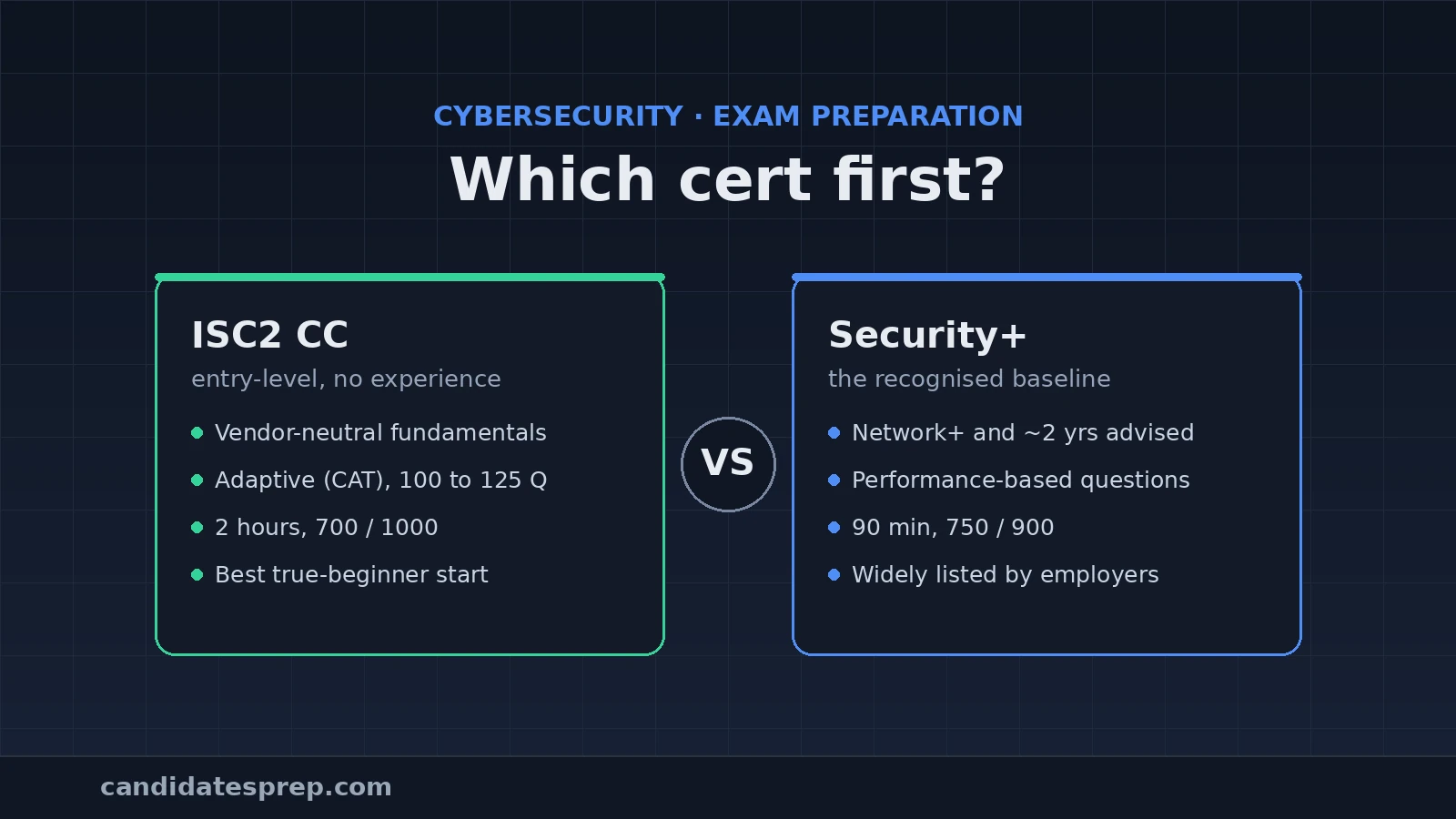
"Should I start with ISC2's Certified in Cybersecurity or CompTIA Security+?" is one of the most common questions from people entering the field, and the honest answer is that they are aimed at slightly different starting points. CC is the gentler, true-beginner entry that assumes no experience. Security+ is the employer-recognised baseline that expects some IT grounding and tests hands-on skills. Here is a fair comparison so you can pick the one that fits where you actually are.
What each certification is
ISC2 Certified in Cybersecurity (CC) is an entry-level, vendor-neutral certification that requires no prior work experience. It covers cybersecurity fundamentals across five domains: security principles; business continuity, disaster recovery and incident response; access controls; network security; and security operations. It is designed as a genuine first step for people who may have no IT background at all.
CompTIA Security+ is a baseline security certification aimed at people moving into security roles. In CompTIA's words, it "establishes the essential skills required for core security functions and a career in IT security", covering securing networks, applications and devices. It is one of the most widely recognised security certifications and is frequently named in job postings and government role requirements.
Difficulty and prerequisites
This is the clearest difference between the two.
- CC has no prerequisites. ISC2 aims it at absolute beginners, and you can sit it with no experience.
- Security+ recommends real grounding. CompTIA's recommended experience is "CompTIA Network+ and two years of experience working in a security/systems administrator job role". That is a recommendation, not a hard requirement, but it signals the level: Security+ assumes you already understand networking and systems.
In practice, most people find Security+ meaningfully harder than CC, both because it goes deeper and because of how it tests you.
How the exams differ
The formats reflect the difference in level.
ISC2 CC:
- Computerised Adaptive Testing, so questions adjust to your performance and you cannot return to a previous question
- 100 to 125 items, multiple choice and advanced item types
- 2 hours
- Passing score of 700 out of 1000
CompTIA Security+ (SY0-701):
- A maximum of 90 questions, a mix of multiple choice and performance-based questions
- 90 minutes
- Passing score of 750 on a scale of 100 to 900
The standout practical difference is Security+'s performance-based questions, which ask you to carry out or solve a task rather than pick an answer. They reward hands-on familiarity and are exactly the sort of thing untimed reading does not prepare you for. CC, by contrast, is knowledge-based and adaptive, so its challenge is committing to each answer and moving on without a second pass.
Recognition and cost
Security+ has a long track record and very broad employer recognition, which is a large part of its value; many security job listings name it directly. CC is newer, and while recognition is growing, it functions best as a foundation that proves you understand the basics rather than as a role-ready credential on its own. On cost, ISC2 has at times offered CC exam and training free through a wider workforce-development pledge, so it is worth checking current availability on the ISC2 site before paying, whereas Security+ is a paid exam.
A note on timing
Both certifications evolve, so check versions before you book. The CC exam moves to a new outline on 1 September 2026, which we covered in our CC guide. Security+ is currently SY0-701, which CompTIA launched in November 2023 with an estimated retirement around 2026, so a refreshed version is expected; confirm the current exam code on CompTIA's page before committing to study materials.
Which should you choose
- Choose CC first if you are a genuine beginner with little or no IT experience, you want a low-pressure, affordable way to prove foundational knowledge, or you are testing whether a security career is for you.
- Choose Security+ first if you already have some IT grounding, such as networking knowledge or a year or two in a technical role, you are targeting a security job now, and you want a credential employers actively list. Be ready for the performance-based questions.
- Do both, in order, if you are starting from zero but serious about the field. CC then Security+ is a sensible ladder: CC builds and proves the fundamentals, and Security+ then takes you to the employer-recognised baseline.
There is no wrong answer here, only a wrong order for your situation. Starting with Security+ when you have no IT background often means a hard, discouraging first exam; starting with CC when you already have experience can feel like standing still.
Practise for the format, not just the facts
Whichever you pick, the format is where candidates lose marks they should keep. CC's adaptive design punishes hesitation, and Security+'s performance-based questions punish anyone who has only read about the tasks. Full, timed practice that mirrors each exam, including hands-on style questions for Security+, tells you whether you are genuinely ready. CandidatesPrep's simulator runs timed, scored mocks so you can rehearse the conditions as well as the content, and trainers preparing cybersecurity cohorts can track readiness across a whole group.
The bottom line
CC and Security+ are not really rivals; they are rungs. CC is the true entry point that assumes nothing, and Security+ is the recognised baseline that assumes some grounding and tests your hands. Match the certification to where you are now, verify the current exam version before you buy materials, and, if you are starting from zero, treat CC as the first rung rather than a competitor to Security+.
Preparing for CC or Security+, or moving a team through both? Rehearse under timed exam conditions, or book a demo to see cohort readiness on CandidatesPrep.