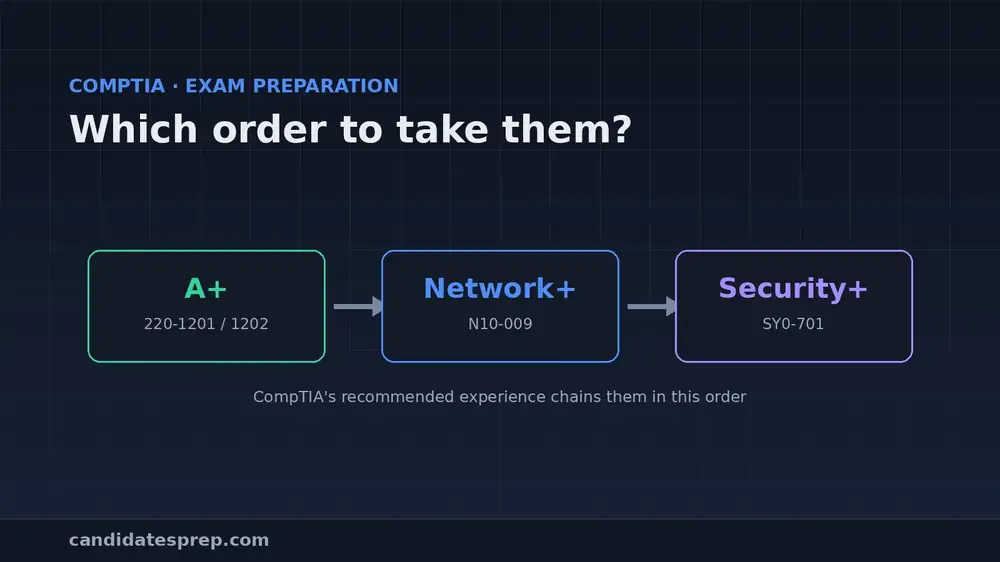
If you are starting a CompTIA IT path, the common question is which of A+, Network+ and Security+ to take first. CompTIA does not print a single "do these in this order" sentence, but its own recommended-experience notes chain the three together, which points to a clear answer: A+, then Network+, then Security+. Here is why that order works and how to plan it.
The three certifications, and what each expects
Read the recommended experience for each and the pathway appears on its own.
- CompTIA A+ (V15, exams 220-1201 and 220-1202). The entry point. Each Core exam has a "maximum of 90" questions including "multiple-choice, drag-and-drop, and performance-based questions" in "90 minutes". Core 1 passes at "675 (on a scale of 900)" and Core 2 at "700 (on a scale of 900)", and you must pass both Core exams to earn A+. Recommended experience: "12 months of hands-on experience in an IT support specialist job role". It assumes no prior certification.
- CompTIA Network+ (V9, exam N10-009). A "maximum of 90" questions, "90 minutes", passing at "720 (on a scale of 100-900)". Its recommended experience names "CompTIA A+ certification, with 9 to 12 months of hands-on experience" in a junior networking role. So Network+ itself points back to A+.
- CompTIA Security+ (V7, exam SY0-701). A "maximum of 90" questions, "90 minutes", passing at "750 (on a scale of 100-900)". Its recommended experience names "CompTIA Network+ and two years of experience". So Security+ points back to Network+.
That chain, Security+ recommending Network+, and Network+ recommending A+, is the official basis for the A+ then Network+ then Security+ order.
Are these prerequisites mandatory?
No, and this matters. CompTIA frames A+ and Network+ as recommended experience, not enforced prerequisites. You are not blocked from sitting Security+ without Network+. The order is advice about what makes each exam manageable, not a locked gate.
That gives you room to adapt:
- Complete beginner with no IT background? Follow the full path: A+ first to build fundamentals, then Network+, then Security+.
- Already working in IT with solid networking knowledge? You may reasonably start at Network+ or even Security+, treating the earlier certs as optional. The recommendation exists to stop people sitting a hard exam with no grounding, not to force a beginner's route on an experienced technician.
- Targeting a security role specifically? Security+ is the recognised baseline, but arriving with Network+ knowledge makes it far more approachable. If you are choosing your first security cert, our comparison of ISC2 CC and CompTIA Security+ is worth a read.
How to plan the path
- Match the starting rung to your real experience, not to a sense of obligation. Starting too high means a hard, discouraging first exam; starting too low can feel like standing still.
- Note that A+ is two exams. Budget for both Core 1 and Core 2, since you need both to earn the certification.
- Expect performance-based questions throughout. All three include hands-on tasks, so prepare to do, not just recall.
Practise under real exam conditions
Each of these exams caps at 90 questions in 90 minutes and mixes in performance-based tasks that eat time, so pacing decides as much as knowledge. Full, timed mocks that include hands-on style questions build the clock discipline the real exams demand and show you which domain is costing you marks. CandidatesPrep's simulator runs timed, scored practice across the pathway, and trainers moving cohorts from A+ to Security+ can track readiness for each step.
Exam-day tactics
- Flag time-consuming performance-based questions and clear the multiple-choice marks first, then return.
- Read each question for exactly what it asks before answering.
- Answer everything; there is no penalty for guessing.
- For A+, treat Core 1 and Core 2 as two separate preparation targets.
The bottom line
CompTIA does not mandate an order, but its recommended experience chains A+ to Network+ to Security+, which is the sensible default path for a beginner. Treat it as advice, not a gate: match your starting point to your real experience, budget for A+ being two exams, and practise the performance-based questions under timed conditions.
Working through the CompTIA path, or training a team on it? Practise under timed exam conditions, or book a demo to see how trainers track readiness on CandidatesPrep.