The PMI Agile Certified Practitioner (PMI-ACP) is PMI's agile credential, and its current exam is built on four domains: Mindset, Leadership, Product and Delivery. If your revision notes are organised around a longer list of agile domains and tool-and-technique groupings, they reflect an older version of the exam. This post sets out what the PMI-ACP tests now, who qualifies to sit it (PMP holders, take note), and how to prepare efficiently.
What the exam tests
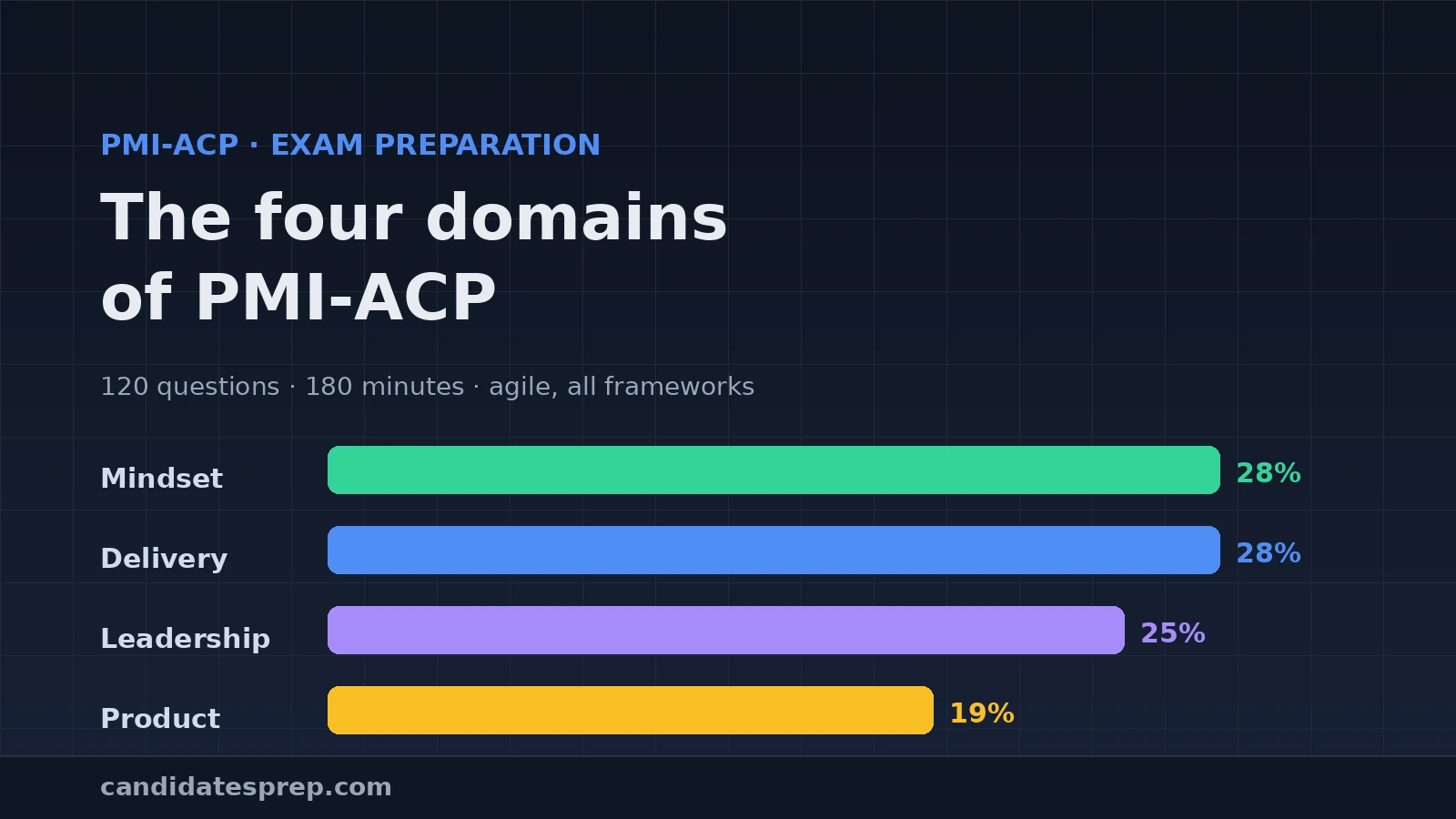
PMI-ACP covers agile broadly rather than any single framework, so it spans Scrum, Kanban, Lean, extreme programming and hybrid approaches. The current exam is weighted across four domains:
- Mindset: 28 per cent
- Leadership: 25 per cent
- Product: 19 per cent
- Delivery: 28 per cent
Two things stand out. First, Mindset and Delivery are the heaviest domains at 28 per cent each, so they deserve the most revision time. Second, this four-domain structure is the shape to study to. Older PMI-ACP materials were organised differently, so if a course or question bank uses a different domain list, it predates the current outline. Download the current PMI-ACP Exam Content Outline directly from PMI and let that document, not a second-hand summary, drive your plan.
The format
The exam itself is straightforward to describe:
- 120 multiple-choice questions
- 180 minutes
- one 10-minute break
That works out to roughly 90 seconds per question, which is comfortable if you keep moving and do not get stuck. The questions are scenario-based, asking what an agile practitioner should do in a given situation, so recognising a definition is rarely enough; you need to apply it.
Who qualifies, and the shortcut people miss
Eligibility has three parts, and one route through it is widely overlooked. You need:
- a secondary school diploma or higher, and
- agile experience, satisfied by any one of: two years of agile experience in the past five years; a degree from a GAC-accredited programme plus one year of agile experience; or a third-party agile certification plus one year of agile experience, and
- 21 hours of formal training in agile practices, frameworks and methodologies.
The shortcut: holding the PMP satisfies the agile-experience requirement on its own. If you are already a PMP, you do not need to separately document years of agile experience to be eligible for PMI-ACP. For the large number of project managers who added agile to predictive and hybrid work, that makes PMI-ACP a much shorter step than they assume. You will still need the 21 hours of formal agile training, but the experience gate is cleared.
How to prepare, domain by domain
Weight your study to the exam, not evenly across topics.
- Mindset (28 per cent). The agile values and principles, and crucially why they exist. Expect questions that reward the agile response over the process-heavy one. This is where candidates from a predictive background lose marks, because the "correct" answer is often the one that favours adaptability and collaboration.
- Delivery (28 per cent). How value actually gets produced: iterations, flow, prioritisation, feedback loops and continuous improvement. Hands-on familiarity with how teams really run beats memorised definitions here.
- Leadership (25 per cent). Servant leadership, facilitation, coaching, and enabling teams rather than directing them. Situational judgement dominates.
- Product (19 per cent). Value, the customer, and how product decisions are made and adjusted. Smallest domain, but do not skip it.
Because PMI-ACP is framework-agnostic, do not over-index on Scrum alone. Questions can just as easily sit in a Kanban, Lean or hybrid context, and a Scrum-only preparation leaves gaps the exam will find.
Practise under real exam conditions
PMI-ACP is 120 scenario questions against the clock, and the difference between passing comfortably and running out of steam is usually pacing and applied judgement rather than raw knowledge. Full, timed mock exams that mirror the real sitting, and that score you by domain, show you exactly whether Mindset or Delivery is where your marks are leaking, so your last fortnight of study goes where it counts. CandidatesPrep's simulator runs timed, domain-scored mocks so you can rehearse the pace as well as the content, and trainers preparing agile cohorts can track readiness across the whole group.
Exam-day tactics
- Read for the most agile response, not the most controlling one.
- At about 90 seconds a question, flag anything that stalls you and move on.
- Watch for framework-neutral wording; the scenario may not be Scrum.
- Answer every question, as there is no penalty for guessing.
The bottom line
The PMI-ACP is a four-domain, framework-agnostic agile exam: Mindset and Delivery at 28 per cent each, Leadership at 25, Product at 19, over 120 questions in 180 minutes. Study to the current Exam Content Outline rather than older materials, weight your time towards the two heavy domains, and if you already hold the PMP, remember that your experience requirement is already met. Prepare for applied judgement across agile as a whole, and the four domains stop being a hurdle.
Preparing for PMI-ACP, or training an agile cohort? Practise under timed exam conditions, or book a demo to see domain-level analytics on CandidatesPrep.