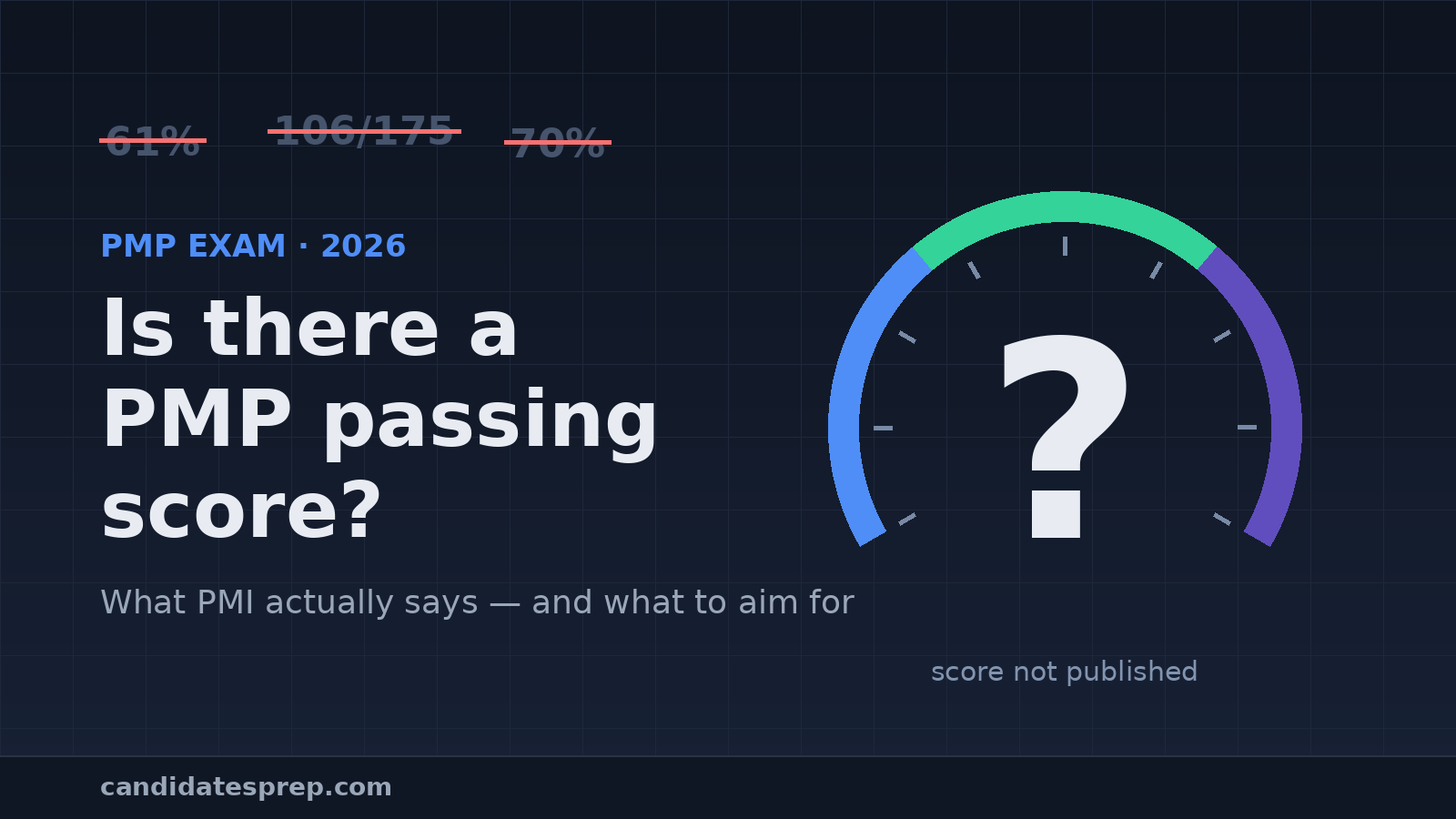
Ask ten PMP candidates what score they need to pass and you will hear ten confident answers: 61%, 106 out of 175, "about 70%". Here is the uncomfortable truth every one of those numbers is folklore. PMI does not publish a passing score for the PMP exam, and it never has for the current exam. This post explains how PMP scoring actually works, why the myths persist, and what target you should aim for instead.
The short answer
There is no published PMP passing score. PMI's certification handbook states that the passing score for its exams is determined through sound psychometric analysis not a fixed percentage. Any site quoting an exact pass mark is repeating a number PMI has never confirmed. The often-cited "61%" comes from a brief period around 2005 when PMI did disclose a figure, before withdrawing it. That was more than two decades and several exam versions ago.
How the exam is actually scored
The PMP exam has 180 questions taken over 240 minutes, with two 10-minute breaks. A small number of questions are unscored pretest items being trialed for future exams you cannot tell which, so treat every question as if it counts.
Rather than a raw pass mark, PMI uses psychometric methods to set the difficulty-adjusted standard. In practice, two candidates can answer a different number of questions correctly and both pass, because the difficulty of the specific questions they received is taken into account. This is standard practice for high-stakes professional exams; it keeps the credential consistent even as questions rotate in and out of the item bank.
Your score report will not show a percentage either. Instead you receive a performance rating for each of the three exam domains People (33%), Process (41%) and Business Environment (26%) under the Exam Content Outline that took effect in July 2026 on a scale from Needs Improvement to Above Target.
Why the myths persist
Three reasons. First, that brief 2005 disclosure gave the internet a number, and the internet never lets go of a number. Second, training providers like a concrete target because "aim for 61%" is easier to sell than "aim for proficiency". Third, candidates naturally want certainty before a four-hour exam that carries a real cost in time and preparation.
The trouble is that studying to a fictional pass mark distorts how you prepare. If you believe 61% is the bar, scoring 65% on a practice test feels safe. It is not. Not least because the difficulty of your practice questions almost certainly does not match the calibrated difficulty of the real item bank.
What to aim for instead
Since PMI will not give you a number, set your own evidence-based bar:
- Aim for consistent scores of 75% or higher on full-length, timed mock exams. This is a margin-of-safety target, not an official threshold, it builds a buffer against harder-than-average question sets and exam-day nerves.
- Track performance by domain, not just overall. A strong overall score can hide a weak Business Environment domain which now carries 26% of the exam, more than triple its weight under the previous outline.
- Watch your trend, not your best result. One good mock proves little. Three consecutive timed mocks at or above your target is real evidence of readiness.
- Practice the full 180-question, four-hour format. Stamina failures look identical to knowledge failures on a score report.
Practice under real exam conditions
Because there is no official score to chase, the quality of your feedback loop matters more than any single number. Full-length, timed simulations that mirror the real exam's structure 180 questions, timed breaks, domain-weighted question distribution tell you far more than casual question drilling. CandidatesPrep's simulator scores every mock by domain, so you can see exactly where you sit against the People, Process and Business Environment split before you book the real thing. Trainers running PMP cohorts can track the same domain-level data across an entire group.
Exam-day tactics
- Answer every question there is no penalty for guessing, and a blank is a guaranteed zero.
- Flag and move on; with 75 to 80 seconds per question on average, one stubborn question is not worth three easy ones.
- Use both 10-minute breaks. You cannot return to earlier sections afterwards, so review flagged questions in the current section first.
- Expect questions that feel ambiguous. The exam rewards the best response, not the only defensible one.
The bottom line
There is no PMP passing score to find, so stop hunting for one. Build your own margin of safety: consistent, domain-balanced results on realistic timed mocks. If your evidence says you are ready, the unpublished pass mark takes care of itself.
If you train PMP candidates, book a demo to see cohort-level domain analytics.