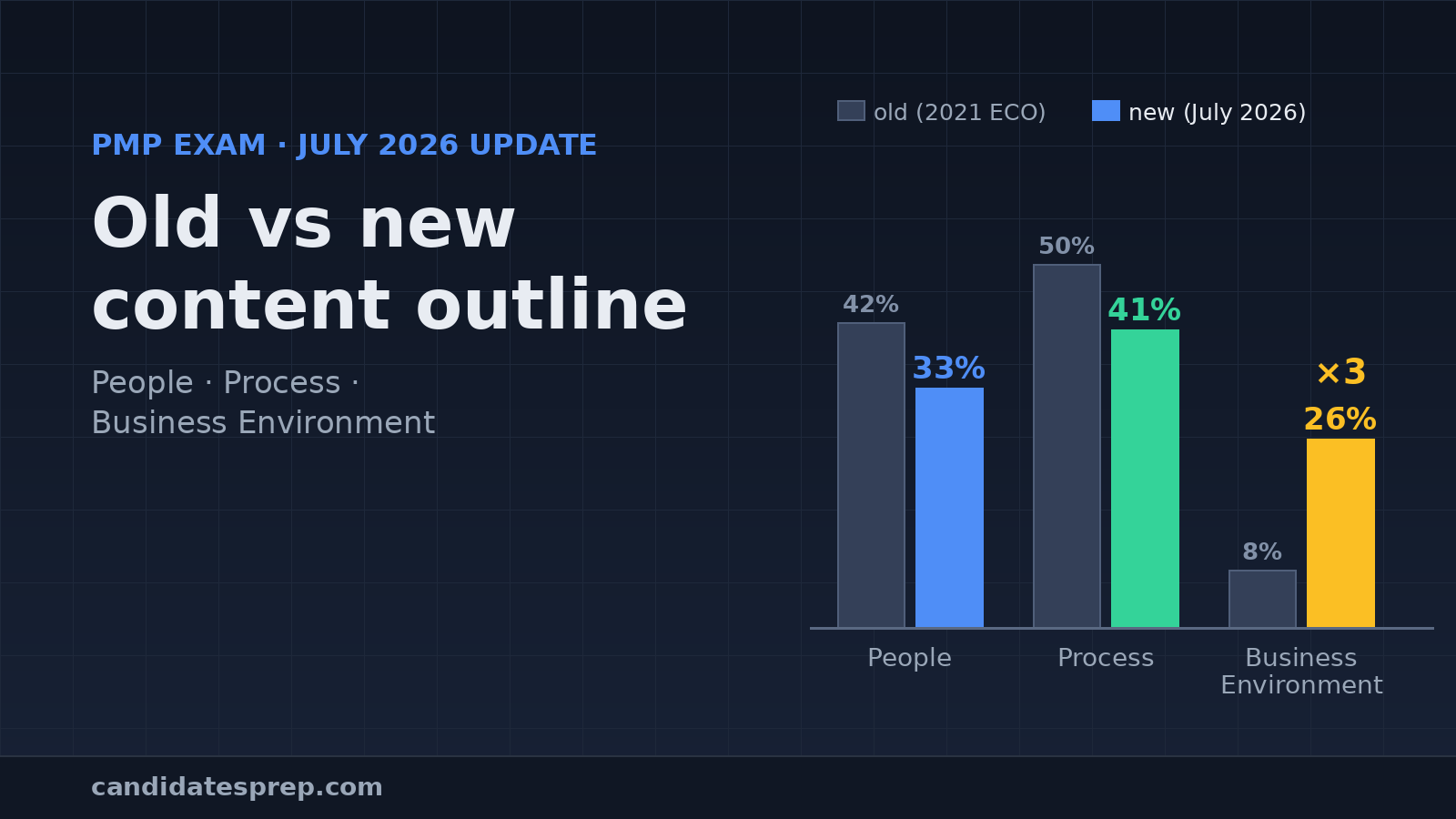
In July 2026, PMI launched the biggest restructuring of the PMP exam in five years. The headline: Business Environment more than tripled, from 8% to 26% of the exam, while People fell from 42% to 33% and Process from 50% to 41%. If your study materials were written for the old outline, they are now weighted for an exam that no longer exists. Here is exactly what changed, what stayed the same, and how to adjust.
Old vs new at a glance
The exam still follows three domains, but the balance between them has shifted substantially. PMI's official exam update page states the change plainly:
- People: 42% to 33%
- Process: 50% to 41%
- Business Environment: 8% to 26%
The format has not been announced as changing. PMI's exam page still lists 180 questions over 240 minutes, with two 10-minute breaks. What changed is what those questions are about.
Why Business Environment is the story
Under the old outline, Business Environment was a rounding error. At 8%, roughly 14 questions, candidates could, and many did, all but skip it. At 26% it is now roughly a quarter of your exam, and PMI says the new content "adds AI, sustainability and stakeholder engagement in project-based scenarios" and "shifts focus to outcomes, value and business impact".
In practice, that means fewer questions you can answer purely from process knowledge, and more that ask how a project decision lands in the wider organisation: benefits, value delivery, compliance, external change, and now how AI tools and sustainability considerations shape project choices. If your practice-exam history shows Business Environment as your weakest domain, that weakness just became three times more expensive.
What stayed the same
PMI is explicit on this point: "If you're already studying older materials, keep going. Core principles and approaches of the PMP exam remain the same." This is not a new exam built from scratch. Predictive, agile and hybrid delivery all still feature, and the bulk of a good study programme carries over. The sensible response is a rebalance, not a restart.
Two changes almost nobody is talking about
Beyond the weightings, PMI's update page carries two quieter changes that affect real decisions:
- Training rules tighten in late Q4 2026. From then, live training hours count towards eligibility only if delivered by a PMI Authorized Training Partner (ATP), a China Registered Education Provider, or an eligible accredited academic programme. If you were planning to use a cheap non-ATP live course for your 35 contact hours, the window for that is closing.
- Eligibility has widened. PMI has expanded eligibility to apprenticeships and training, with a 10-year window for experience. Candidates whose project experience felt "too old" under previous rules should recheck; they may now qualify.
One thing to be careful about: PMI does not publish a fixed passing score for the PMP, and the new outline has not changed that. Any guide quoting an exact pass mark for the "new exam" is guessing.
How to adjust your study plan
- Reweight, don't restart. Keep your core materials, but shift revision time towards Business Environment topics: organisational strategy, benefits and value, compliance, and external business change.
- Check the date on everything. Any course, question bank or guide that still shows 42/50/8 was written for the old exam. It is not useless, but its emphasis is wrong.
- Get comfortable with AI and sustainability scenarios. Not as technical subjects, but as factors in project decisions, because that is how PMI frames them.
- Rebase your mock-exam expectations. A score built on strong People and Process performance flattered you under the old weightings. Under 33/41/26, domain balance matters more.
Practise under the new weightings
The fastest way to find out what the rebalance means for you personally is a full, timed mock scored by domain. If Business Environment comes back as your weak domain, and for most candidates trained on old materials it will, you know exactly where the next fortnight of study goes. CandidatesPrep's simulator runs full 180-question timed mocks with domain-level scoring, and trainers can see the same breakdown across an entire cohort, which makes rebalancing a group's prep straightforward.
Exam-day tactics
- Expect scenario questions that cross domains: a stakeholder problem wrapped in a business-impact frame.
- Read for the outcome the question rewards: value and business impact, not just correct process.
- Manage the clock as three blocks of 60 questions with a break between, and use both breaks.
- Answer every question; there is no penalty for guessing.
The bottom line
The July 2026 PMP is the same exam in structure and spirit, with its centre of gravity moved decisively towards business context. Study materials built for the 42/50/8 exam will still teach you project management. They just won't prepare you for a paper where a quarter of the questions live in the domain you used to skip.
See where you stand under the new weightings. Run a full timed mock, or if you prepare PMP cohorts, book a demo to see domain-level analytics across your candidates.