Six Sigma Green Belt and Black Belt are two levels of the same quality discipline, and the ASQ certifications for them differ in one decisive way. Start with the Green Belt if you support improvement projects and have the work experience; go for the Black Belt when you lead projects and can prove completed ones with signed affidavits. The gap is not just harder questions, it is demonstrated project delivery.
What each level is
A Six Sigma Green Belt works on quality improvement projects, often alongside or under a Black Belt, applying data-driven problem solving and process tools. ASQ's certification for this is the CSSGB.
A Six Sigma Black Belt leads improvement initiatives, masters the DMAIC model in depth, and manages project teams. ASQ's certification is the CSSBB, and it is aimed at people driving organisational change, not just contributing to it.
If your career is heading towards broader project delivery rather than process improvement specifically, it is also worth seeing how these sit next to project management credentials in our guide on how to pass the PMP exam.
The eligibility difference that decides it
This is where the choice is usually made for you, taken from ASQ:
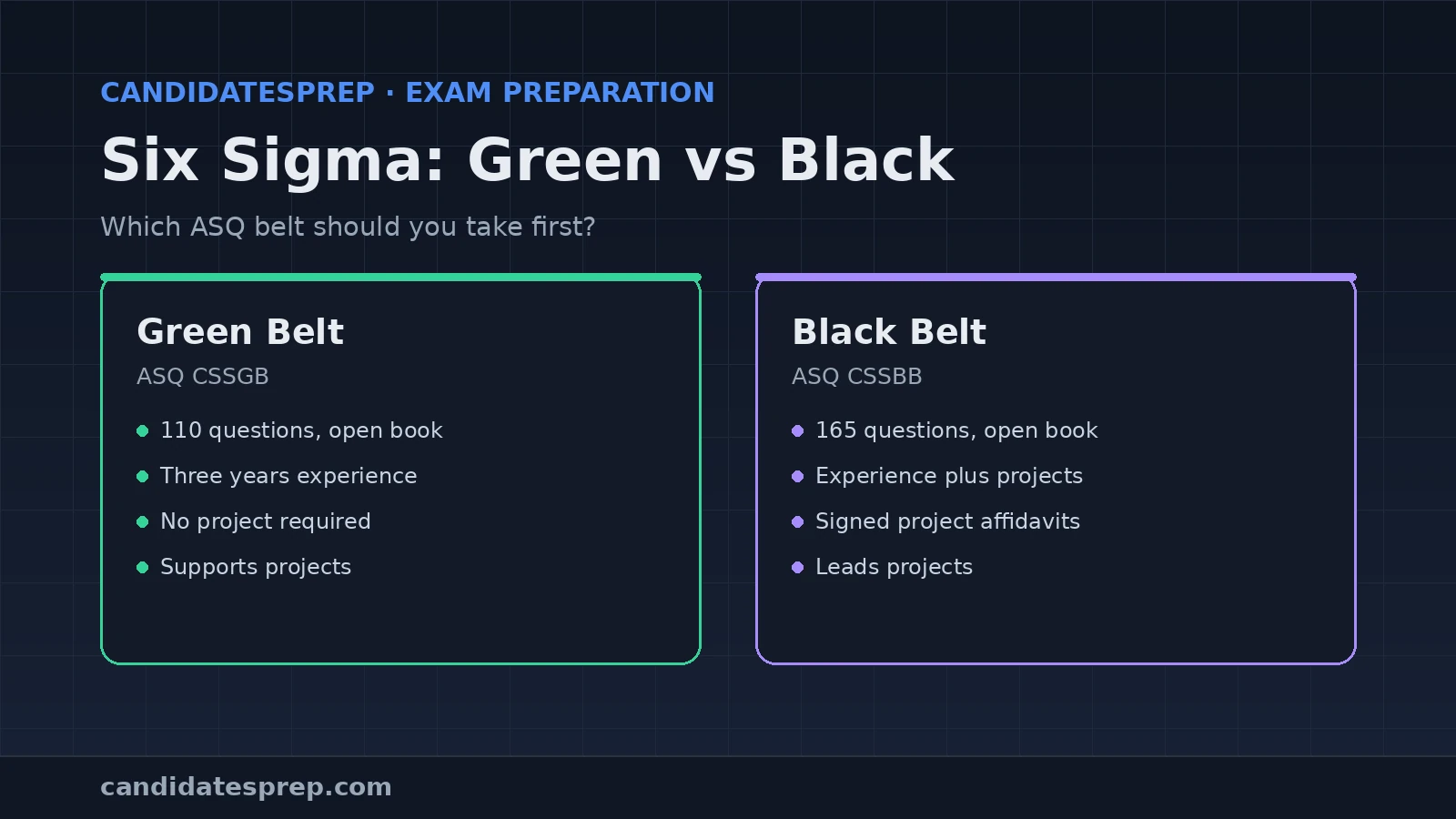
- CSSGB (Green Belt): three years of full-time, paid, on-the-job experience in one or more areas of the Green Belt Body of Knowledge. No completed project is required, and educational waivers are not granted.
- CSSBB (Black Belt): three years of experience in one or more areas of the Black Belt Body of Knowledge, plus completed projects. ASQ requires at least one completed Six Sigma project with a signed affidavit, or two completed projects with signed affidavits.
So the Green Belt is open to experienced practitioners who have not yet led their own projects, while the Black Belt specifically requires you to evidence real project work. If you cannot yet sign off completed projects, the Green Belt is the right starting level.
The exams, side by side
Both are open-book, computer-delivered, multiple-choice exams, and you bring your own reference materials.
- CSSGB: a one-part, 110-question exam in English, of which 100 are scored and 10 are unscored. Total appointment time is four and a half hours, with 4 hours 18 minutes of exam time. A 100-question, four-hour paper version is offered in Mandarin in some locations. The exam fee is 483 US dollars, with reduced retakes, and ASQ members save on the initial fee.
- CSSBB: a one-part, 165-question exam in English, of which 150 are scored and 15 are unscored, in the same four-and-a-half-hour appointment with 4 hours 18 minutes of exam time. A 150-question, four-hour paper version is offered in Mandarin in some locations. The exam fee is 585 US dollars, with reduced retakes and the same member discount.
Both are long, calculation-heavy exams where knowing your reference materials well enough to find things fast matters as much as recall.
Which should you choose?
Choose the Green Belt if you contribute to improvement projects, want to prove your command of the tools, and have the three years of experience but not yet your own completed projects. It is the natural first credential and a strong foundation.
Choose the Black Belt if you already lead projects, can evidence completed ones with affidavits, and want the credential that marks you as a driver of organisational improvement. Many people earn the Green Belt first and step up to Black Belt once they have led enough project work to satisfy the affidavit requirement.
Practise under real exam conditions
These exams reward speed and confident tool use across four hours of statistics and process questions, and being open book does not save an unprepared candidate. Full, timed mock exams build both the pace and the habit of finding the right reference fast. On CandidatesPrep you can sit complete simulations scored by section of the Body of Knowledge, so you can see whether it is Measure, Analyse or Improve that is costing you, and repeat until every section is solid. Trainers running Six Sigma cohorts can track everyone's readiness in one place.
Exam-day tactics
- Organise your reference materials with tabs so open book actually saves you time.
- Bring an approved calculator and know how to use it under pressure.
- Manage the four-hour clock; do not sink time into a single calculation.
The bottom line
Green Belt and Black Belt are a progression, and the fork is completed projects. If you have the experience but not the project affidavits, start with the Green Belt. Once you are leading and can evidence real projects, step up to the Black Belt.
Want to know if you are ready before you book? Sit a full timed simulation, or book a demo if you train quality and process improvement teams.