The Duolingo English Test (DET) has become a real alternative to IELTS for study applications, and the choice confuses a lot of candidates. Take the DET if you want a faster, cheaper, at-home test and your destination accepts it; take IELTS if you need the widest acceptance, including visa routes where the DET may not be recognised. Acceptance, not convenience, is the deciding factor.
What each test is
The Duolingo English Test is an online, adaptive English test taken on your own computer at home, monitored remotely. It reports on a single scale and is designed to be quick and low cost.
IELTS is the long-established English test co-owned by the British Council, IDP and Cambridge. It tests four skills and includes a speaking section with a real examiner. If you want the mechanics of its scoring, see how the IELTS band score is calculated, and for the newer TOEFL comparison read TOEFL vs IELTS in 2026.
Format and timing
The two tests feel very different on the day.
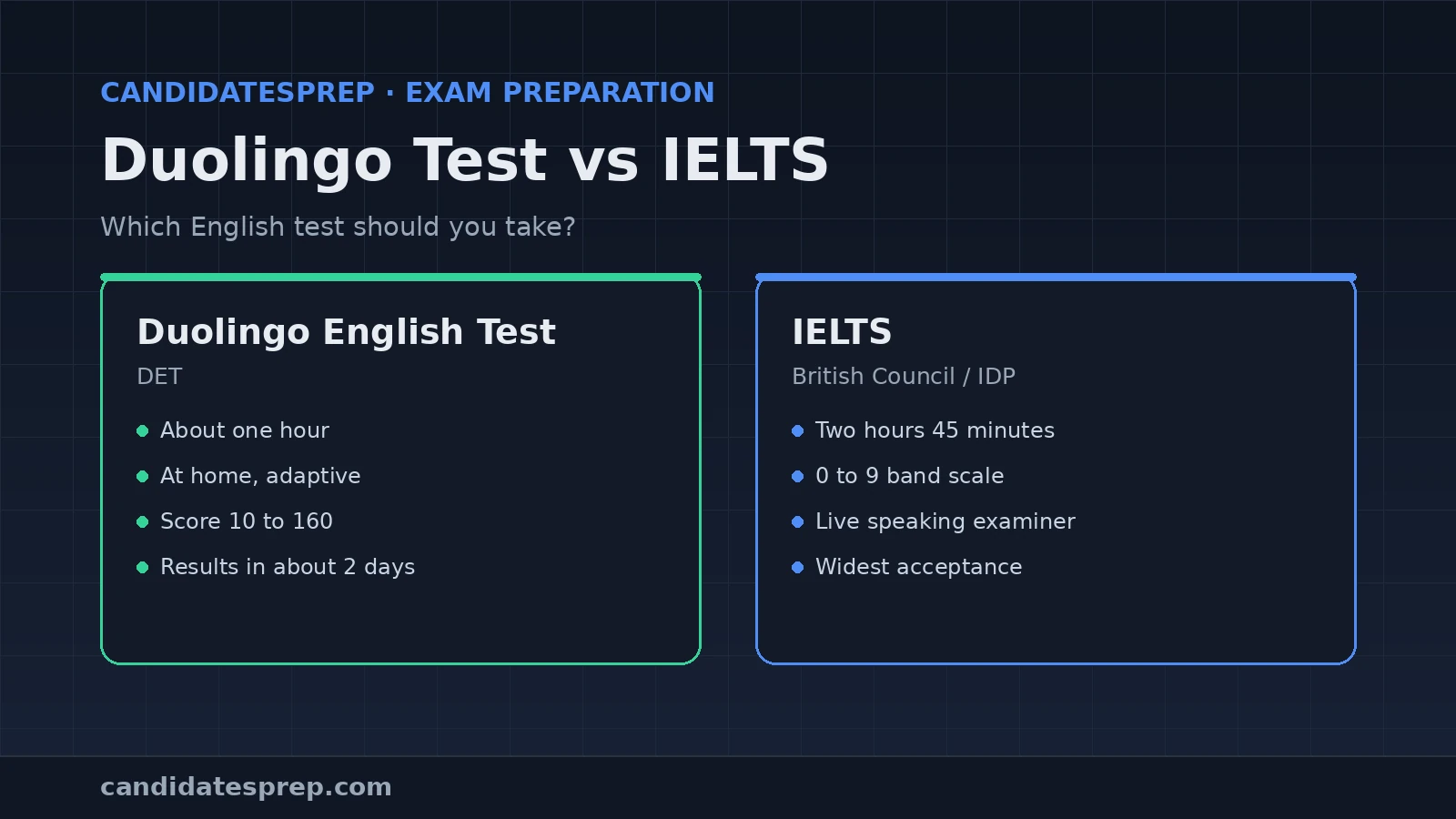
- Duolingo English Test: about one hour end to end, made up of roughly five minutes of setup and ID checks, 45 minutes of scored adaptive questions, and a ten-minute writing and speaking sample sent to institutions. It is taken online with a webcam, it adapts to your answers as you go, and results arrive in about two days.
- IELTS: 2 hours and 45 minutes across Listening (30 minutes), Reading (60 minutes), Writing (60 minutes) and Speaking (11 to 14 minutes). Speaking is a face-to-face conversation with a real examiner, which may be on the same day or within seven days of the other sections.
The speaking difference is the one candidates feel most. The DET records short samples through your microphone; IELTS puts you in a live conversation with an examiner.
Scoring
The DET reports an overall score on a scale of 10 to 160, with subscores for Speaking, Writing, Reading and Listening that average to the overall, plus integrated subscores such as Production and Literacy. IELTS reports each skill and an overall result as a band from 0 to 9 in half-band steps. The two scales are not the same, but Duolingo publishes an official comparison mapping its scores to IELTS bands, so you can translate a target band into a DET score. Always work back from the exact score your destination requires.
The versions question
IELTS comes in Academic and General Training versions, and choosing the wrong one is a costly mistake, so read IELTS Academic vs General Training before you book. The DET is a single test rather than split versions, which is simpler, but only helps if your destination accepts it in the first place.
Which should you take?
Start from acceptance. Confirm whether your specific university, programme or immigration authority accepts the Duolingo English Test and the exact score it requires, because acceptance has grown quickly but is still not universal, and some visa and immigration routes require IELTS or another approved test rather than the DET.
Choose the DET if it is accepted where you are applying and you value speed, lower cost and testing from home. Choose IELTS if you need the broadest acceptance, if your visa route requires it, or if you would perform better speaking to a real examiner than into a microphone.
Practise under real exam conditions
Whichever you take, your result reflects timing and composure as much as your English. The DET's adaptive format and strict at-home rules reward calm familiarity; IELTS rewards handling a long test and a live speaking exam. On CandidatesPrep you can sit full, timed practice that mirrors each format, scored by skill so you can see whether it is Reading pace, Writing structure or Speaking confidence holding you back, then repeat until it is steady. Trainers preparing English-test cohorts can track every candidate's skill scores in one place.
Exam-day tactics
- Confirm your required score and that your test is accepted before you book anything.
- For the DET, prepare your room and lighting; a rule breach can void the test.
- For IELTS Speaking, treat it as a conversation and develop your answers rather than reciting.
- Do not leave anything blank on either test.
The bottom line
The Duolingo English Test wins on speed, cost and convenience; IELTS wins on breadth of acceptance and a human speaking exam. Confirm which one your destination accepts, match your target score to its scale, and then practise the exact format before test day.
Want to see your skill scores before you book? Sit a full timed practice test, or book a demo if you coach English-test candidates.