PRINCE2 and PMP are the two best-known project management credentials, and they are not really rivals. PRINCE2 teaches a specific project method you can apply from day one; PMP validates broad project practice and requires years of documented experience. Which you need depends on where you work and what your target roles ask for.
What each one is
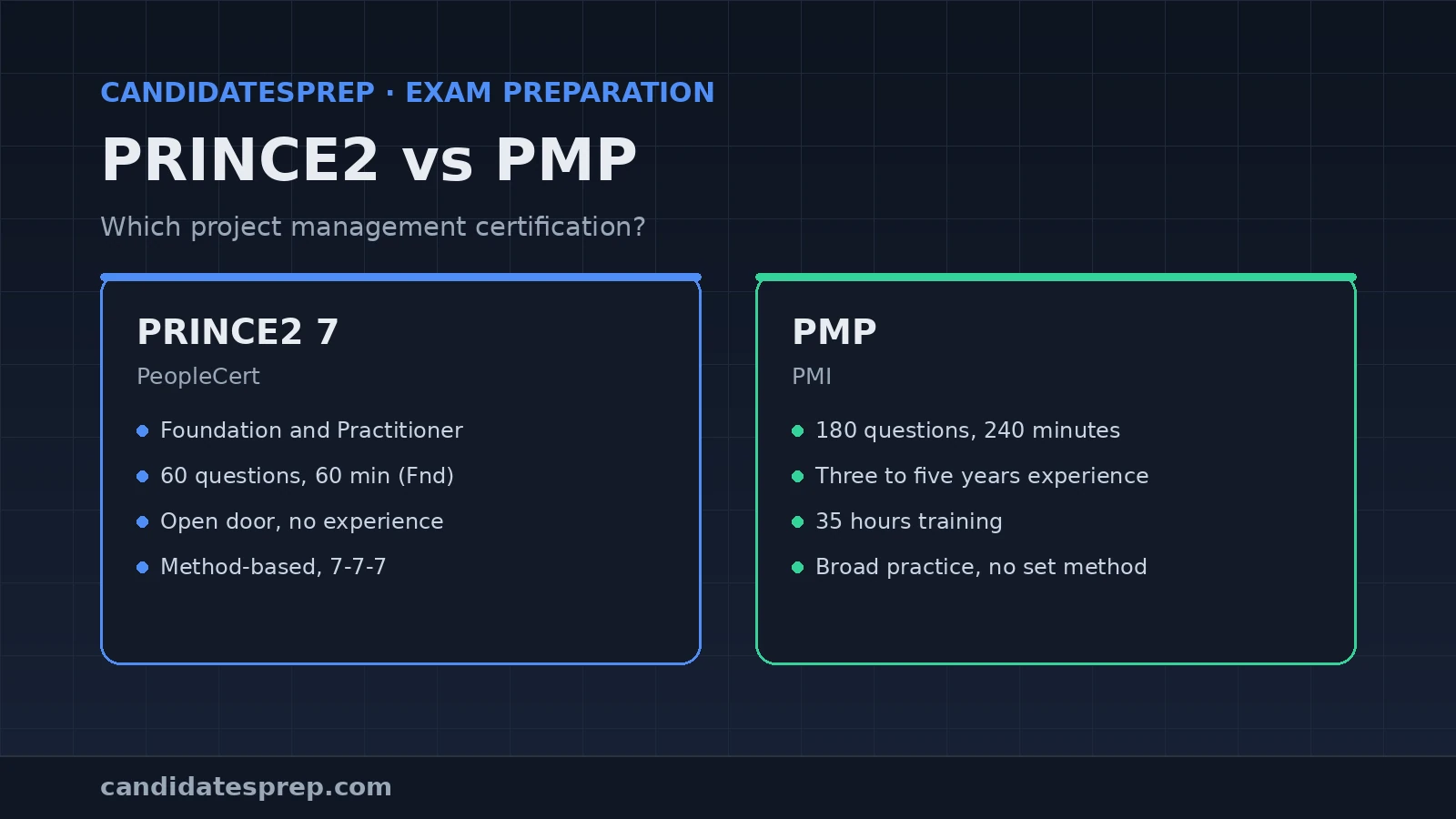
PRINCE2, from PeopleCert, is a structured project management method built on seven principles, seven practices and seven processes. The current version is PRINCE2 7, which adds explicit people, sustainability and digital and data elements. It comes in two levels: Foundation, which tests that you understand the method, and Practitioner, which tests that you can apply and tailor it to a real project.
PMP, from PMI, is a broad professional certification covering predictive, agile and hybrid delivery across three performance domains. It is less about one prescribed method and more about proving experienced judgement. If PMP is your target, start with our guide on how to pass the PMP exam.
The exams, side by side
Taken from the issuing bodies:
- PRINCE2 7 Foundation: 60 multiple choice questions, 60 minutes, closed book, pass mark 60 percent. No prerequisite.
- PRINCE2 7 Practitioner: 56 questions and sub-questions worth 70 marks, 150 minutes, open book with the official manual, pass mark 60 percent. It requires a prerequisite, and usefully PMP or CAPM both qualify, as does PRINCE2 Foundation.
- PMP: 180 questions, 240 minutes, with two scheduled breaks, across the People, Process and Business Environment domains.
The eligibility difference
This is the practical fork.
- PRINCE2 Foundation is open to anyone. You can sit it with no experience, which makes it a strong entry point and a fast way to prove method knowledge.
- PMP requires experience. With a four-year degree you need three years of leading projects, or five years with a secondary degree, plus 35 hours of project management training. We cover the full entry picture, including the lighter CAPM route, in CAPM vs PMP.
So if you cannot yet evidence years of running projects, PRINCE2 is available now and PMP is not.
Neither publishes PMP-style folklore scores
PRINCE2 states its pass mark plainly at 60 percent for both levels. PMI does not publish a fixed passing percentage at all, reporting performance by domain instead, which we explain in is there a PMP passing score. Do not carry a PRINCE2 pass-mark mindset into the PMP.
Which should you choose?
Choose PRINCE2 if you work in, or want to work in, the UK, Europe, Australia or other markets and sectors where the method is the common language, or if you want a certification you can earn now without an experience gate. Foundation proves you know the method; Practitioner proves you can run a project with it.
Choose PMP if your target employers name it directly, which is common in North America and in multinational roles, and if you already have the experience to qualify. It signals broad, tested project judgement rather than one method.
Because PMP can serve as the entry ticket to PRINCE2 Practitioner, many experienced managers hold both: PMP for breadth and recognition, PRINCE2 for a concrete method to run projects by. They complement rather than cancel each other.
Practise under real exam conditions
The two exams fail people in different ways. PRINCE2 Practitioner is open book, so speed and knowing where to find things in the manual matter as much as recall. PMP is dense with situational judgement across four hours. Reading about the format is not the same as sitting it. On CandidatesPrep you can take full, timed simulations that mirror each exam's question style and clock, scored so you can see exactly which practices, processes or domains are letting you down, and repeat until they are solid. Trainers running PRINCE2 or PMP cohorts can track everyone's readiness in one place.
Exam-day tactics
- For PRINCE2 Practitioner, practise navigating the official manual quickly; open book rewards preparation, not browsing.
- For PMP, read every scenario for what it is really asking before looking at the options.
- Answer everything. Neither exam rewards a blank over a considered guess.
The bottom line
PRINCE2 gives you a method and an open door; PMP gives you broad, experience-backed recognition behind an eligibility gate. Pick by your market and your experience, and remember that holding both is a common and sensible path, not a waste.
Want to know if you are ready before you book? Sit a full timed simulation, or book a demo if you train project managers.