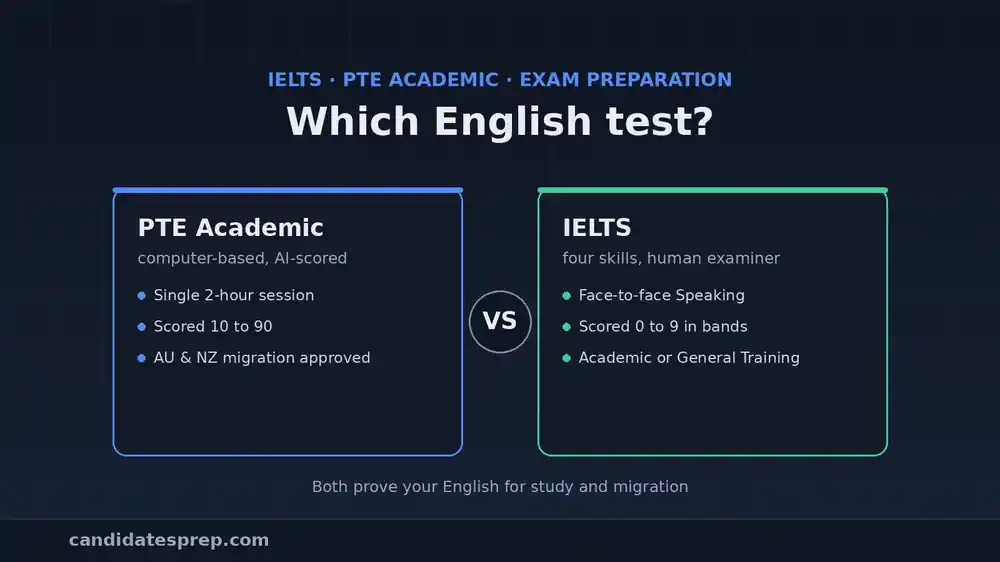
If you need to prove your English for study or migration, two of the most widely accepted tests are PTE Academic and IELTS. They test the same four skills but feel very different to sit: PTE Academic is a single computer-based session marked entirely by AI, while IELTS keeps a face-to-face speaking test with a human examiner. Which is right for you depends on where you are applying and how you perform under each format. Here is a fair comparison.
What each test is for
IELTS is accepted for university study and professional registration, and comes in two versions: Academic and General Training. The distinction matters, and we cover it in full in our guide to IELTS Academic vs General Training. In short, Academic is for higher education, and General Training is for migration to Australia, Canada, New Zealand and the UK, and for below-degree study or work.
PTE Academic is, in Pearson's words, "accepted for study by 4,000+ universities and colleges worldwide" and "accepted by virtually all universities in Australia, Canada, New Zealand, and the UK". For migration, Pearson states it is "approved by Australia and New Zealand for work and migration visas" and "accepted by the Department of Home Affairs (DHA) in Australia and Immigration New Zealand for all immigration visa types".
One important accuracy point: while Pearson lists PTE Academic as accepted for study by UK universities, do not assume plain PTE Academic covers every UK visa route. UK visas can require a specific approved test version, so confirm the exact requirement with the receiving university or immigration authority before you book.
How they differ to sit
This is where the two really diverge.
- Format. PTE Academic is "a single, computer-based test" that assesses all four skills "in just 2 hours at a test center". IELTS tests Listening, Reading, Writing and Speaking, and crucially its "Speaking test is a face-to-face interview between the test taker and an examiner" lasting "11 to 14 minutes".
- Marking. PTE Academic is scored by AI. Pearson says "automated scoring matches the way an expert examiner would mark your test" using "sophisticated algorithms, based on hundreds of thousands of real test responses". IELTS uses trained human examiners for Writing and Speaking.
- Scoring scale. PTE Academic reports "on a 10 to 90 scale". IELTS reports on a nine-band scale from 0 to 9, in whole and half bands. We explain the IELTS calculation in how the IELTS band score is calculated.
Which should you choose
- Choose PTE Academic if you are comfortable speaking into a microphone rather than to a person, you want a fast computer-marked result, and your destination (especially Australia or New Zealand study or migration) accepts it. Some candidates simply score better when a machine, not a nervous conversation, marks their speaking.
- Choose IELTS if you prefer a real conversation for the speaking test, your institution or visa route specifies IELTS, or you are taking General Training for migration where IELTS is the established option.
The deciding factor is rarely which is "easier". It is which one your university, employer or immigration authority actually requires, and which format suits how you perform. Confirm the accepted test and the minimum score in writing before booking.
Practise under real exam conditions
Both tests are strictly timed, and both punish poor pacing more than gaps in knowledge. PTE Academic in particular moves quickly through integrated tasks, and IELTS rewards candidates who have rehearsed the format. Full, timed practice that mirrors your chosen test, scored by section, shows you which skill is holding your result back so your final weeks target it. CandidatesPrep's simulator runs timed, section-scored practice, and teachers preparing English-test cohorts can track readiness across a whole class.
The bottom line
PTE Academic and IELTS both prove your English for study and migration, but they feel different: PTE is a fast, single computer session marked by AI, while IELTS keeps a human, face-to-face speaking test. Choose by what your destination accepts and which format suits you, confirm the required score at the source, then practise in the right test under timed conditions.
Preparing for PTE Academic or IELTS, or teaching a class? Practise under timed conditions, or book a demo to see how teachers track readiness on CandidatesPrep.