CAPM and PMP are both PMI certifications, but they sit at different career stages. Take the CAPM first if you are new to projects and cannot yet prove years of leading them; take the PMP once you have the experience PMI requires. The deciding factor is not difficulty alone, it is eligibility.
What each exam tests
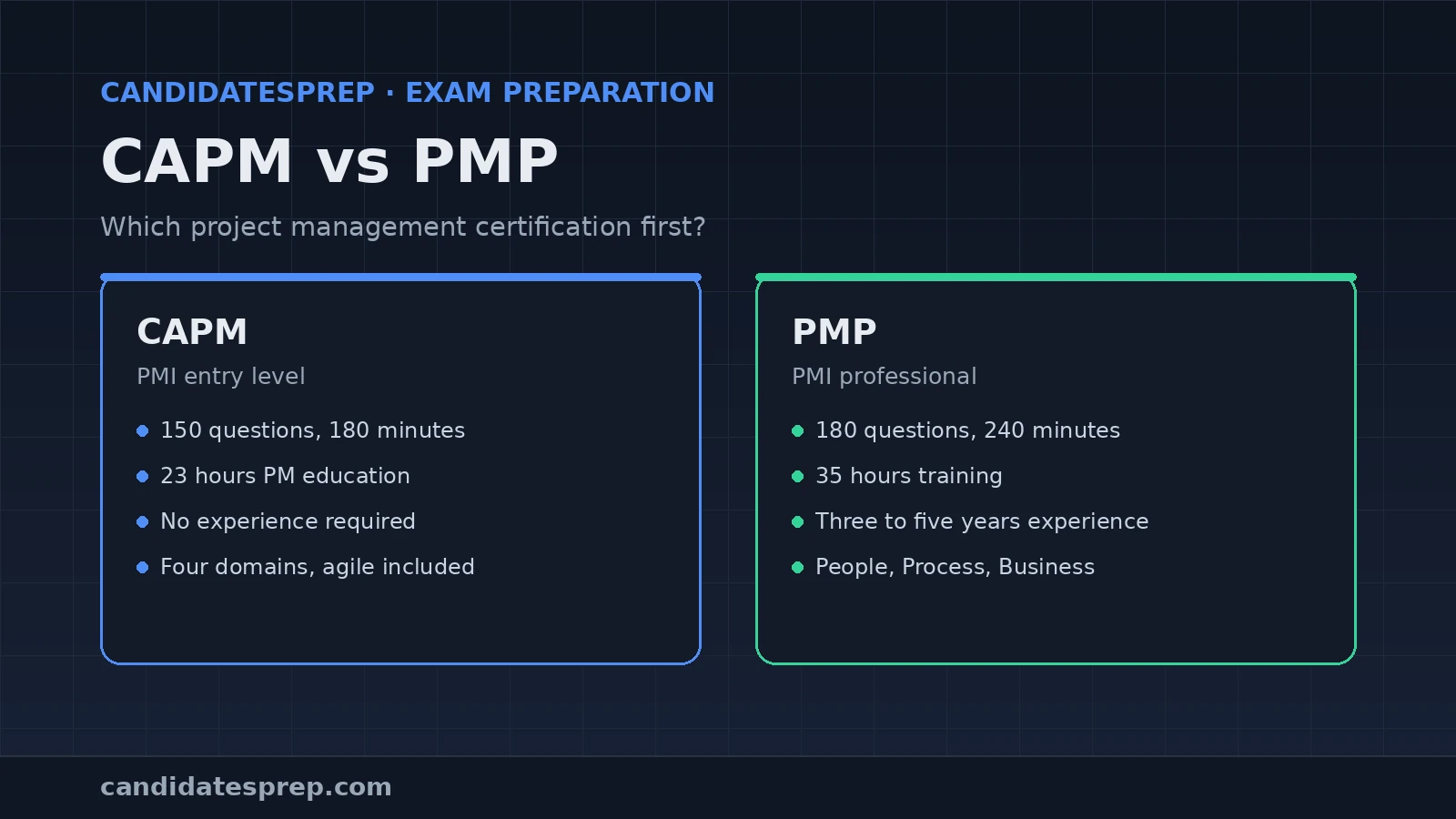
The CAPM (Certified Associate in Project Management) is PMI's entry-level credential. The exam has 150 questions, of which 135 are scored and 15 are unscored pretest items, and you have 180 minutes. The content outline splits across four areas: Project Management Fundamentals and Core Concepts at 36 percent, Business Analysis Frameworks at 27 percent, Agile Frameworks and Methodologies at 20 percent, and Predictive, Plan-Based Methodologies at 17 percent. So more than half of the exam now sits outside traditional predictive planning, which surprises candidates who only study waterfall.
The PMP (Project Management Professional) is the senior credential. It has 180 questions across 240 minutes, with two scheduled breaks. Its three domains are People at 33 percent, Process at 41 percent, and Business Environment at 26 percent, and roughly half the questions are written around agile or hybrid delivery. You can read our full guide on how to pass the PMP exam.
The eligibility gap that decides it
This is where the choice is usually made for you.
- CAPM requires a secondary degree, such as a high school diploma or global equivalent, plus at least 23 hours of project management education completed before you sit. That 23 hours is satisfied by PMI's own online course or an equivalent, and there is no work-experience requirement.
- PMP requires both experience and training. With a four-year degree you need three years of leading projects; with a secondary degree you need five years. Either path also requires 35 hours of project management training, or a current CAPM.
If you cannot yet document years of running projects, the PMP is simply not open to you, and the CAPM is the sensible first step.
Is there a passing score?
Neither exam publishes a fixed passing percentage. PMI scores against psychometric performance across the domains and reports a result of Above Target, Target, Below Target, or Needs Improvement per section, not a raw mark. Chasing a mythical "61 percent" wastes energy. We explain this in detail for the senior exam in is there a PMP passing score. The practical takeaway is the same for both: aim to be comfortably strong in every domain rather than scraping one number.
How to choose in practice
Choose the CAPM if you are a student, a recent graduate, or someone moving into project coordination who wants a recognised credential now. It proves you understand the vocabulary and the frameworks, and it satisfies part of the PMP training requirement later.
Choose the PMP if you already lead projects and can evidence the hours. It carries more weight with employers and is the standard many project management roles ask for by name. Many people do both in sequence: CAPM to enter, PMP once the experience is banked.
One more note on timing. PMI refreshes its exam content outlines periodically, so always download the current outline from PMI before you build a study plan, and check whether a new version is scheduled near your exam date.
Practise under real exam conditions
Both exams reward familiarity with the format, not just the theory. The CAPM mixes predictive, agile and business-analysis questions in an unpredictable order, and the PMP leans heavily on situational judgement. The gap most candidates feel on the day is pacing and question style, not knowledge.
That is what full, timed mock exams are for. On CandidatesPrep you can sit complete simulations that mirror the real question count and clock, scored by domain so you can see whether it is Process, People or Agile that is dragging you down. Trainers running CAPM or PMP cohorts can track every candidate's domain scores in one place and target revision where it is actually needed.
The bottom line
CAPM and PMP are not competitors, they are a ladder. If you have the experience, the PMP is the stronger credential and worth going straight for. If you do not, the CAPM gets you certified now and counts towards the PMP later. Let your eligibility, not your ambition, pick the starting rung.
Ready to test yourself under exam conditions? Try a full timed simulation, or book a demo if you train candidates and want cohort-level scoring.