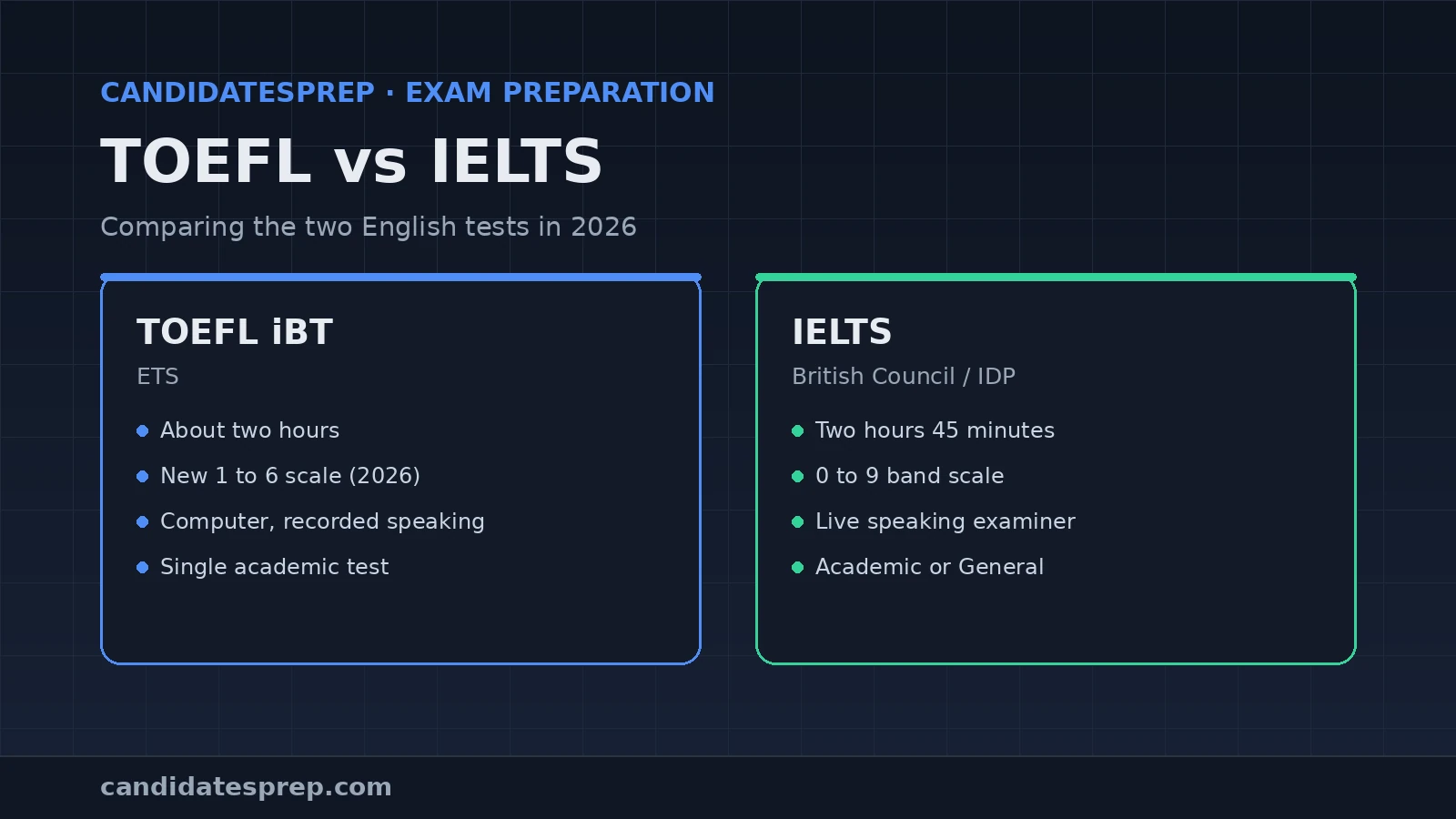
TOEFL and IELTS both prove your English for study, work and migration, and most universities accept either. The biggest 2026 update is on the TOEFL side: from January 2026 it reports on a new 1 to 6 scale, while IELTS keeps its familiar 0 to 9 bands. Choose based on format, timing and, above all, the exact score your destination requires.
The headline scoring change
ETS has moved the TOEFL iBT to a 1 to 6 scale. You receive a score for each of the four sections and an overall score, and the overall is the average of the four section scores rounded to the nearest half band. For a two-year transition period after January 2026, ETS also reports a comparable overall score on the old 0 to 120 scale, so institutions still quoting a 0 to 120 requirement can be matched during the changeover.
IELTS is unchanged here. It reports each skill and an overall result as a band from 0 to 9, in half-band steps. If you want the mechanics, our guide to how the IELTS band score is calculated breaks it down.
The practical effect: the two tests now look more alike, both reporting a small banded number, but the scales are not interchangeable. Always work back from the specific score your university, employer or immigration authority asks for.
Format and timing
The tests structure the same four skills differently.
- TOEFL iBT covers Reading, Listening, Writing and Speaking, and ETS advises allowing about two hours in total. It is delivered on a computer, either at an authorised test centre or as the TOEFL iBT Home Edition monitored by a live human proctor, and the test adapts as you go. Speaking is recorded and scored, so you speak into a microphone rather than to a person.
- IELTS covers Listening, Reading, Writing and Speaking across 2 hours and 45 minutes: Listening 30 minutes, Reading 60 minutes, Writing 60 minutes, and Speaking 11 to 14 minutes. Speaking is a face-to-face conversation with a real examiner, which may be on the same day or within seven days of the other sections.
That Speaking difference is the one most candidates feel. If talking to a person steadies you, IELTS suits you; if you prefer recording answers without an interviewer watching, TOEFL does.
Academic and General versions
IELTS comes in two versions, Academic and General Training, with the same Listening and Speaking but different Reading and Writing. Picking the wrong one is a common and costly mistake, so read our guide on IELTS Academic versus General Training before you book. TOEFL iBT is a single academic-focused test, which keeps the choice simpler if a university will accept it.
Which should you take?
Start from the requirement, not the test. Confirm whether your destination accepts TOEFL, IELTS, or both, and the exact minimum score, including any per-skill minimum. Then let format preference decide between them. Choose TOEFL if you are comfortable with a fully computer-based test and recorded speaking, and IELTS if you prefer a live speaking examiner or need the General Training version for migration.
Practise under real exam conditions
For both tests, your band or score is set as much by stamina and timing as by your English. Reading under a strict clock, keeping Writing to the task, and handling Speaking without freezing are all rehearsable. On CandidatesPrep you can sit full, timed practice tests that mirror each format and clock, scored by section so you can see whether it is Reading pace or Writing structure holding you back, then repeat until it is steady. Trainers preparing English-test cohorts can track every candidate's section scores in one place and target coaching where it counts.
Exam-day tactics
- Confirm your required score and any per-skill minimum before you even choose a test.
- For TOEFL, rehearse speaking into a microphone against the clock so recording feels natural.
- For IELTS, treat Speaking as a conversation; short, developed answers beat memorised speeches.
- Do not leave blanks. Neither test penalises a wrong answer more than a missing one.
The bottom line
In 2026 the two tests sit closer together, with TOEFL on a new 1 to 6 scale and IELTS on its 0 to 9 bands, but they are still distinct in format, timing and speaking style. Pick the one whose score your destination accepts and whose format plays to your strengths, then practise it under real conditions.
Want to see your section scores before test day? Sit a full timed practice test, or book a demo if you coach English-test candidates.