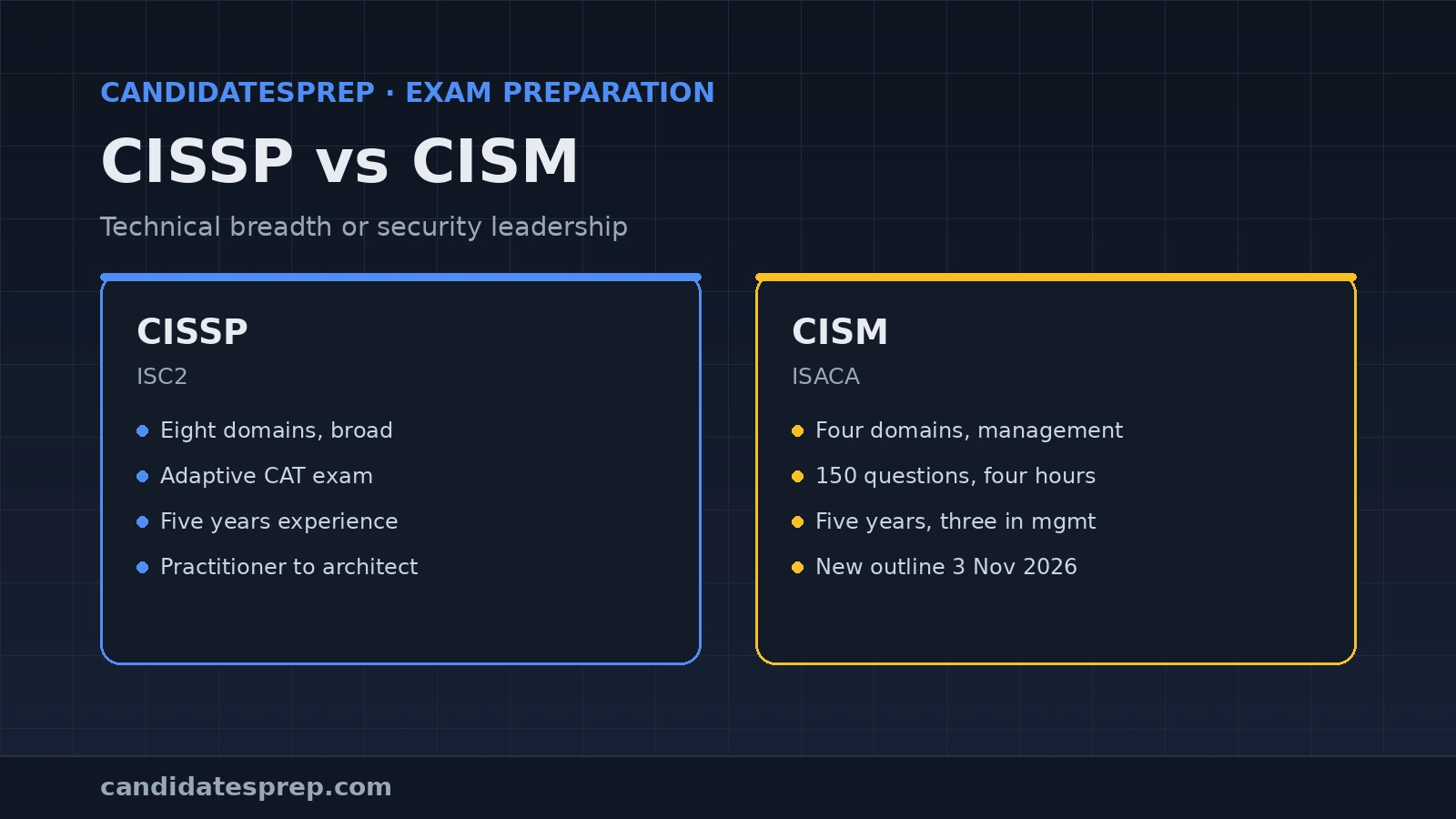
CISSP and CISM are both senior security certifications, and both ask for five years of experience, so this is not a beginner-versus-expert choice. Choose the CISSP if you want broad, technical security breadth and a practitioner-to-architect path; choose the CISM if your career is heading into security management and governance. One proves you can build security; the other proves you can run it.
What each one covers
CISSP, from ISC2, is built around eight domains: Security and Risk Management, Asset Security, Security Architecture and Engineering, Communication and Network Security, Identity and Access Management, Security Assessment and Testing, Security Operations, and Software Development Security. It is deliberately wide, spanning hands-on and strategic knowledge.
CISM, from ISACA, is narrower and leadership-oriented, built around four domains: Information Security Governance, Information Security Risk Management, Information Security Program, and Incident Management. The centre of gravity is managing a security programme, not configuring the controls yourself.
If you are earlier in cybersecurity, start with the fundamentals first. Our comparison of ISC2 CC and CompTIA Security+ covers the entry-level step before either of these.
The exams
Always confirm the current figures on the official pages, but as they stand:
- CISSP is delivered in English as a computerised adaptive test, administered in person at Pearson VUE centres. Per ISC2's exam outline it runs between 100 and 150 items in up to three hours, with a scaled pass mark of 700 out of 1000. Check the live details on the ISC2 CISSP page.
- CISM is a fixed-form exam of 150 questions across four hours, with a scaled score where 450 out of 800 passes, per ISACA. Confirm the current details on the ISACA CISM page.
One security note worth knowing before you book: ISC2 has tightened test-centre screening from June 2026, including scans for hidden recording devices, so plan for stricter check-in.
A 2026 change that affects CISM candidates
ISACA has confirmed that the CISM Exam Content Outline will be updated with effect from 3 November 2026, and the exam will follow the new outline from that date. Updated preparation material goes on sale in September 2026, and older material will not automatically grant access to the new version. If you are sitting CISM around that window, decide deliberately: study and sit against the current outline before 3 November, or prepare against the new outline after it. Do not mix the two.
The experience requirement
Both credentials need real experience, and both let you sit the exam first and satisfy the experience afterwards.
- CISSP asks for five years of paid work experience across at least two of its eight domains, with a one-year reduction available for an approved degree or credential. Pass first, and you become an Associate of ISC2 while you accrue the time.
- CISM asks for five years of information security work experience, with at least three years in security management across the relevant domains. Certain qualifications can waive part of the general experience.
How to choose
Go for CISSP if you are a security engineer, analyst, architect or consultant who wants recognised technical breadth, or if job adverts in your target roles name it directly, which many do. Go for CISM if you are moving into or already in a manager, programme lead or governance role, where the conversation is about risk, strategy and running teams rather than building controls. Plenty of senior professionals eventually hold both.
Practise under real exam conditions
These are long, high-pressure exams, and the failure mode is rarely a knowledge gap alone. It is fatigue, pacing, and second-guessing. The CISSP adaptive format in particular rewards steady accuracy over speed. Full, timed mock exams rehearse exactly that. On CandidatesPrep you can sit complete simulations scored by domain, so you can see whether it is governance, risk, or a technical area that is holding your score down, and repeat until your weak domains come up to standard. Trainers preparing corporate security teams can track a whole cohort's domain performance in one place.
The bottom line
CISSP and CISM are not rivals so much as two directions of travel: technical breadth versus security leadership. Match the credential to where your career is going, check the official exam pages for the latest figures, and if you are eyeing CISM, plan around the 3 November 2026 outline change.
Want to gauge your readiness before you book? Sit a full timed security simulation, or book a demo if you prepare security teams at scale.