Both PSM and CSM certify you as a Scrum Master, and both are respected. The real difference is how you earn them. Choose the CSM if you want a guided two-day course before you are tested; choose the PSM if you would rather study independently, pay less, and hold a certification that never expires. One is course-first, the other is knowledge-first.
What the two certifications are
PSM I (Professional Scrum Master I) is issued by Scrum.org. CSM (Certified ScrumMaster) is issued by Scrum Alliance. They test overlapping knowledge, the Scrum framework, the Scrum Master accountabilities, and how the Scrum Guide applies in practice, but they gate that test very differently.
The exams, side by side
Here is what each assessment actually looks like, taken from the issuing bodies.
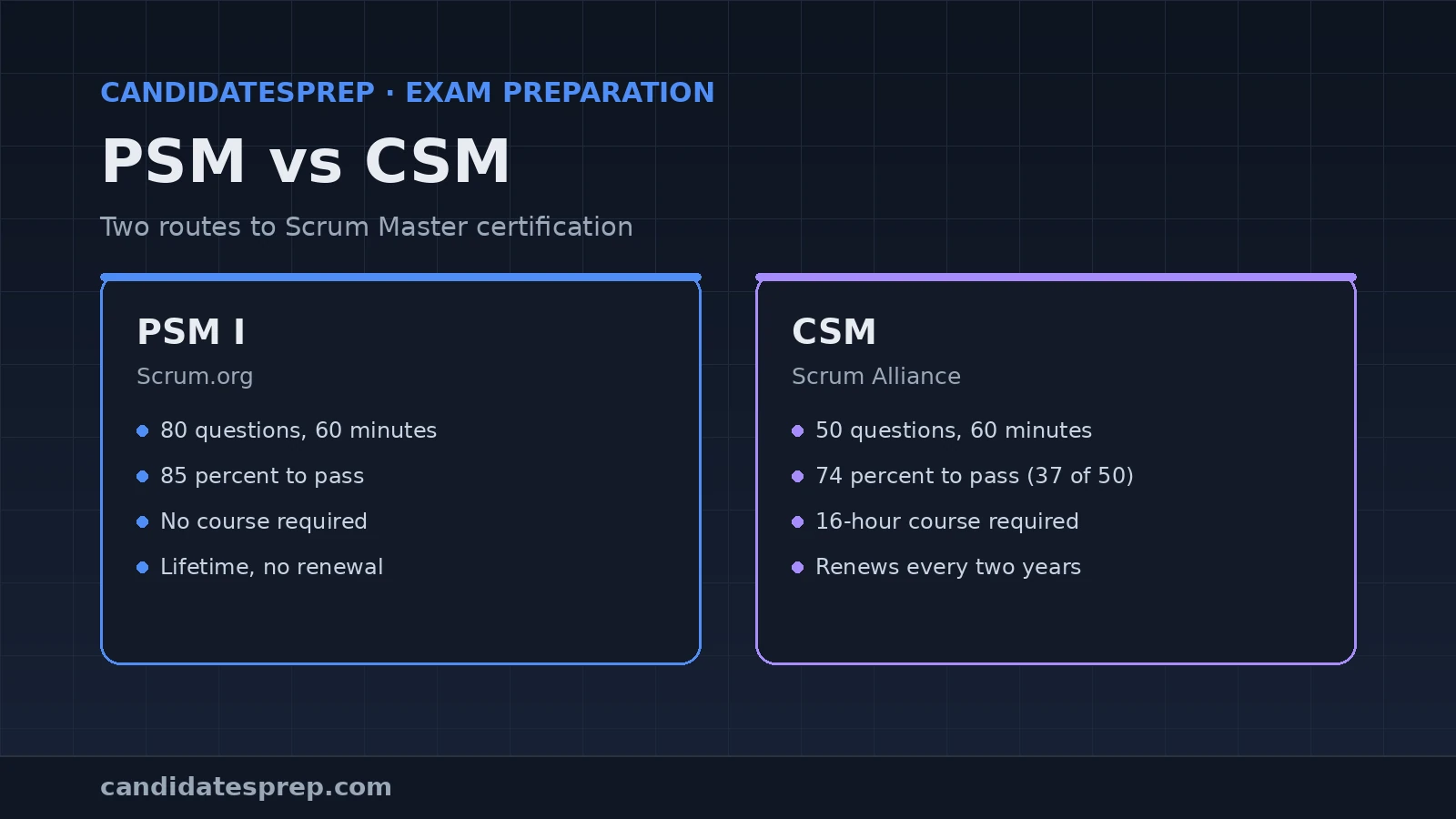
- PSM I: 80 questions in 60 minutes, with a pass mark of 85 percent. The format mixes multiple choice, multiple answer and true or false. It costs 200 US dollars per attempt, and there is no prerequisite, although Scrum.org strongly recommends a course. The certification is for life, with no renewal fee.
- CSM: 50 multiple-choice questions in 60 minutes, with a pass mark of 74 percent, which is 37 correct out of 50. You get two free attempts within 90 days of finishing the course. Crucially, you must first complete an approved 16-hour course delivered by a Certified Scrum Trainer before you can sit the test.
That course requirement is the headline difference. With CSM the training is mandatory and built into the price; with PSM you can register and sit the test on your own preparation.
Cost and renewal over time
PSM is a one-off. You pay per attempt, you pass, and the certification does not expire, so there is no ongoing cost. Passwords for the test are valid for a single attempt, so the 85 percent bar matters.
CSM carries a longer-term commitment. The value is in the live course and the trainer, but the certification runs on a two-year cycle and must be renewed by earning Scrum Education Units and paying a renewal fee. Over several years that adds up, so factor it in if you are paying yourself.
Which one employers want
In most markets the two are treated as equivalent entry-level Scrum Master credentials, and job adverts often list either. The reputational nuance is this: because PSM has no attendance shortcut and a higher pass mark, some hiring managers read it as proof of independent knowledge. CSM signals you have sat through structured, trainer-led learning. Neither is universally "better," so look at what the roles you want actually ask for.
If your Agile path is leading you towards project delivery, it is also worth seeing how these sit alongside PMI's agile credential in our guide to passing the PMI-ACP.
How to prepare for either
Read the current Scrum Guide until it is second nature; both exams are built directly on it. Then drill under time pressure. The PSM catches people out on wording and on the 60-minute clock against 80 questions, roughly 45 seconds each. The CSM is gentler on timing but still rewards knowing the accountabilities cold.
Practise under real exam conditions
Whichever body you choose, the gap on test day is usually pace and phrasing, not understanding. Full, timed mock assessments fix that. On CandidatesPrep you can sit complete Scrum Master simulations that match the real question count and clock, then review which competency areas, empiricism, the events, the artefacts, or team facilitation, cost you marks. Trainers delivering CSM courses or coaching PSM candidates can track a whole cohort's readiness and target the weak spots before anyone pays for the real thing.
Exam-day tactics
- Answer every question; there is no penalty for guessing, and both tests are tight on time.
- Flag and move on. Do not lose four minutes on one wording trap.
- Trust the Scrum Guide over workplace habits. The exam tests the framework as written, not your team's local variations.
The bottom line
PSM and CSM lead to the same role from different directions. PSM is cheaper over time, has no compulsory course, and never expires, but demands a high 85 percent on your own study. CSM builds in a two-day trainer-led course and a gentler pass mark, at the cost of the course fee and ongoing renewal. Pick the path that matches how you learn and what your target employers list.
Want to know if you are ready before you pay? Sit a full timed Scrum simulation, or book a demo if you train Scrum cohorts.