A good multiple-choice question tests whether someone knows the answer, not whether they can decode the question. The fixes are simple: a clear stem that poses one problem, one defensibly correct answer, and distractors that are wrong but plausible. Here is how to write items that measure what you actually intend.
The three parts of an item
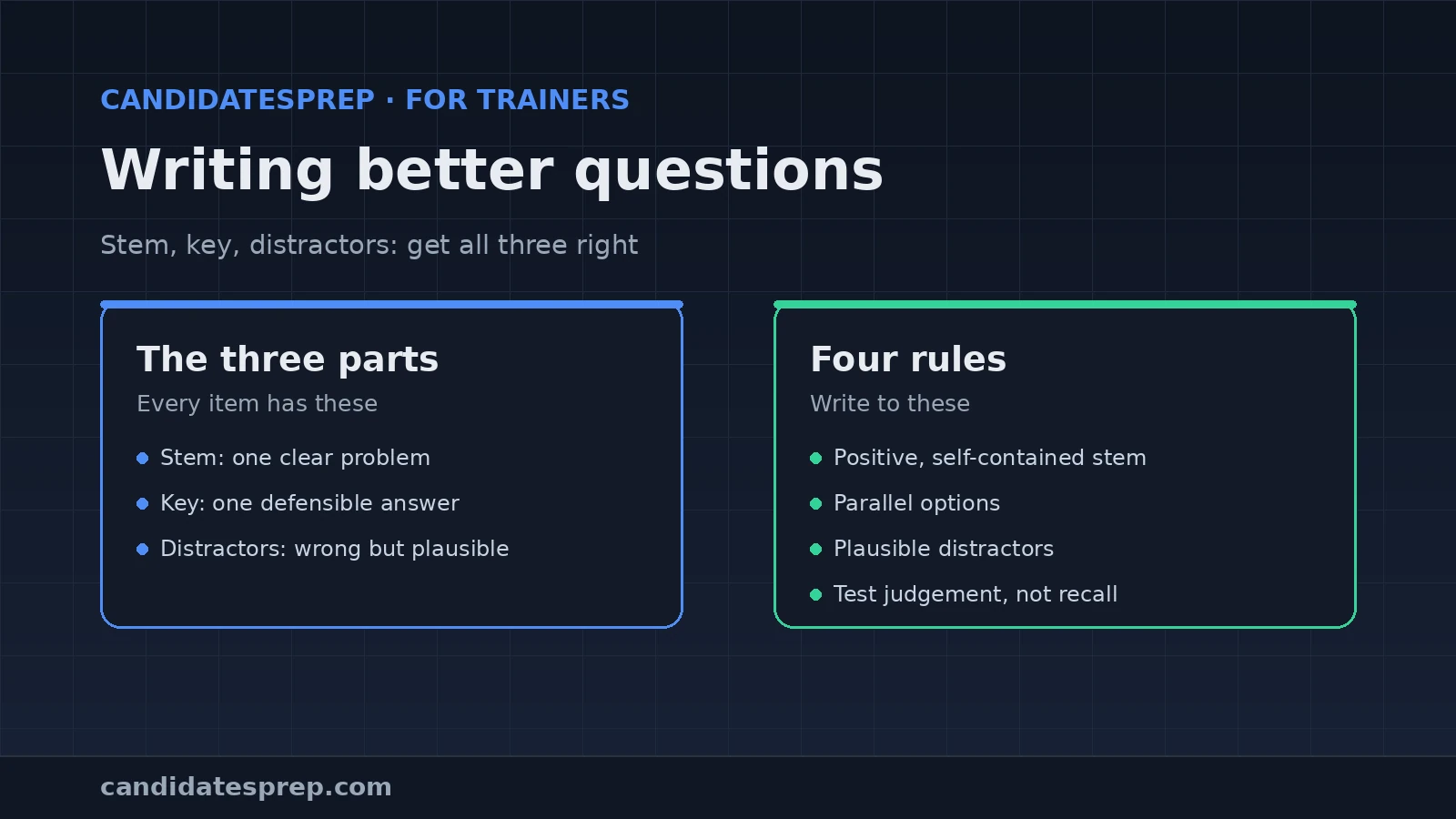
Every multiple-choice item has three parts: the stem (the question or problem), the key (the correct option), and the distractors (the plausible wrong options). Almost every weak question fails in one of these three places. Professional assessment bodies such as the National Board of Medical Examiners publish detailed item-writing guides; the rules below are the ones that matter most in practice.
Write a clear, self-contained stem
- Pose one complete problem in the stem, so that a strong candidate could almost answer before reading the options.
- Phrase it in positive form. If you must use a negative such as "which is not", make the negative word bold so it is not missed.
- Cut filler and clever wording. You are testing the subject, not reading speed or your own vocabulary.
Make the options clean and parallel
- Include exactly one clearly correct answer. "Best answer" items are fine, but the key must be defensibly the best, not merely arguable.
- Keep options similar in length, grammar and detail. A key that is longer or more qualified than the rest gives itself away.
- Avoid "all of the above" and "none of the above". They let partial knowledge score full marks or turn the item into a logic puzzle.
- Order options logically, for example numerically or alphabetically, so their position leaks no clue.
Make the distractors plausible
Weak distractors are the single most common flaw. A distractor should be wrong, but wrong for a reason a real candidate might genuinely believe, ideally a common misconception. If everyone eliminates two options on sight, your four-option question is really a two-option one, and it is far easier to guess. Harvest your distractors from the actual mistakes learners make.
Test judgement, not just recall
Pure recall questions are quick to write and quick to outsource to a search engine or an AI tool. Questions that give a short scenario and ask what to do, or why, are harder to game and tell you far more about competence. Aim for a mix, weighted towards application for anything high-stakes.
Review and improve with data
Even careful items misbehave. After an exam, look at how each question performed. An item almost everyone gets wrong may be miskeyed or ambiguous; a distractor no candidate ever chooses is dead weight taking up space. This is item analysis, and used steadily it raises the quality of your whole question bank. Our guide on building a question bank covers the workflow.
Deliver and analyse in one place
Writing good items is only half the job; you also have to deliver them fairly and see how they perform. CandidatesPrep lets you build randomised banks, deliver timed proctored mocks, and score by topic, so you can spot weak questions and weak candidate areas in the same place and track a cohort over time.
The bottom line
Clear stem, one defensible answer, plausible distractors, and a bias towards applied judgement. Write to those four rules, then let item analysis refine the rest.
Build and deliver a better question bank: explore the CandidatesPrep simulator, or book a demo to set it up for your institute.