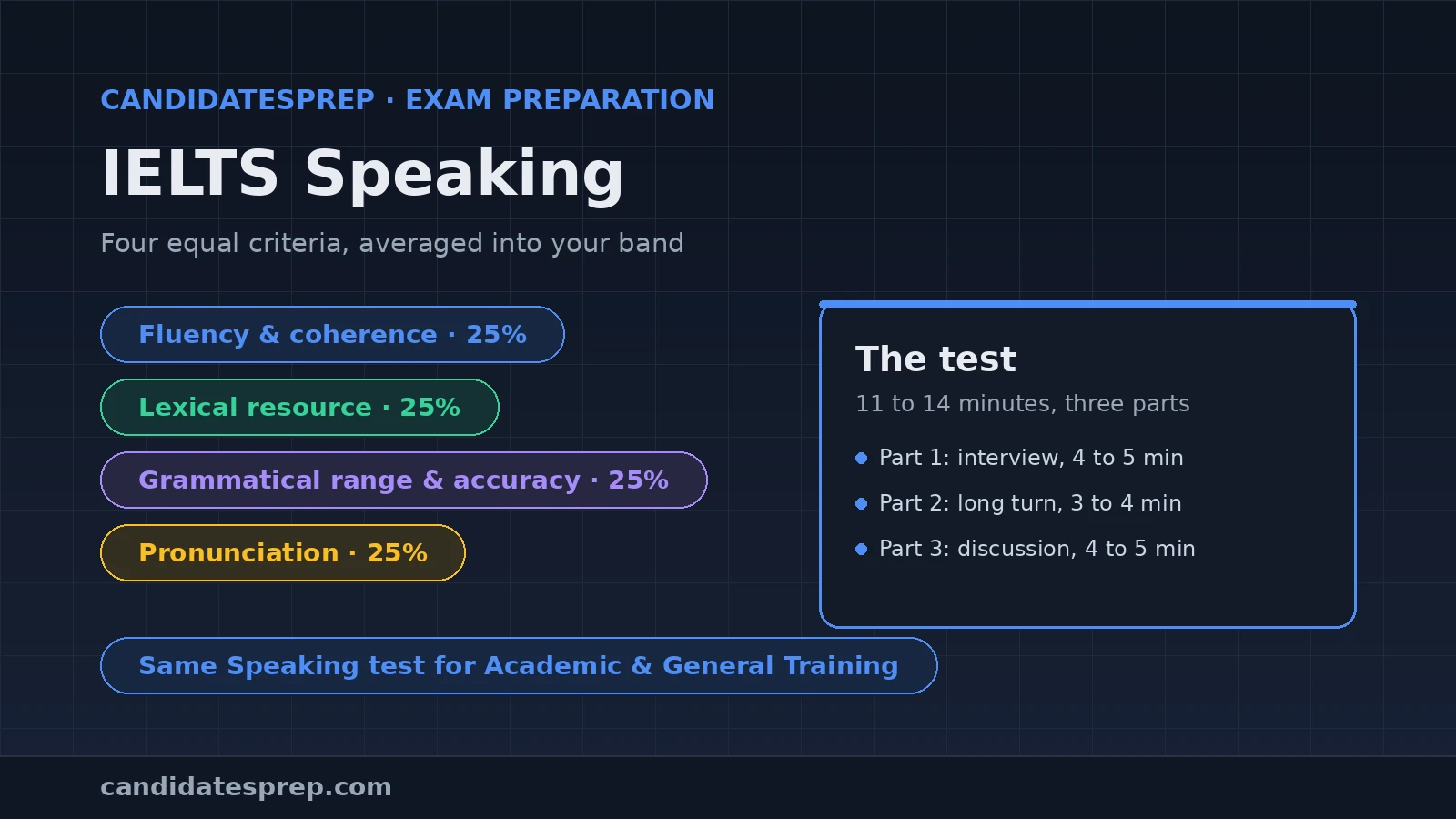
Your IELTS Speaking band is the average of four equally weighted criteria: fluency and coherence, lexical resource, grammatical range and accuracy, and pronunciation. The test is an 11 to 14 minute conversation with an examiner in three parts, and the same Speaking test is used for both Academic and General Training.
How Speaking is scored
An examiner scores you on four criteria, each carrying equal weight:
- Fluency and coherence
- Lexical resource
- Grammatical range and accuracy
- Pronunciation
You receive a band from 0 to 9 on each criterion, and the average becomes your Speaking band, reported in whole or half bands. Because the four are equal, a single weak area drags the whole score down, so it rarely pays to perfect one criterion while ignoring another. For how Speaking then combines with the other three sections, see how the IELTS band score is calculated.
The three parts
The test runs 11 to 14 minutes in total, face to face or by video call with a real examiner:
- Part 1, introduction and interview, 4 to 5 minutes: everyday questions about home, family, work, studies or interests.
- Part 2, the long turn, 3 to 4 minutes including preparation: you get a task card and one minute to make notes, then speak for up to two minutes, after which the examiner may ask one or two follow-up questions.
- Part 3, discussion, 4 to 5 minutes: a broader, more abstract two-way discussion linked to the Part 2 topic.
The Speaking and Listening tests are the same for Academic and General Training; only Reading and Writing differ. If you are unsure which test you need, read our guide to Academic versus General Training.
What each criterion rewards
- Fluency and coherence: speaking at length without long pauses or repeated fillers, and linking ideas logically.
- Lexical resource: the range and precision of your vocabulary, including less common words and the ability to paraphrase, used naturally rather than forced.
- Grammatical range and accuracy: a mix of simple and complex structures with few errors that get in the way of meaning.
- Pronunciation: clear, natural speech with good use of stress, rhythm and intonation, understood without strain.
Notice what is not on the list: no marks for a "correct" accent, for sounding clever, or for agreeing with the examiner. You are marked on how well you communicate.
How to lift each part
In Part 1, never give one-word answers. Add a reason or an example to every response, but do not launch into a rehearsed speech; keep it natural.
In Part 2, use the full preparation minute. Jot a quick plan rather than full sentences, for example who, what, where, and why it mattered, then talk to your notes so you never dry up before the two minutes are done.
In Part 3, treat it as a discussion, not an interrogation. Give an opinion, back it with a reason, then add an example or a contrast. Phrases that buy thinking time, such as "that is an interesting question", are fine in moderation.
Across all three, self-correct once if you slip and then move on. Chasing a mistake wastes fluency you cannot get back.
Practise under real exam conditions
Speaking is the hardest section to rehearse alone, because the pressure is conversational and live. Record yourself answering real prompts against the three-part timing, then listen back for pauses, repeated words and grammar slips.
CandidatesPrep supports the rest of your IELTS preparation with timed Listening and Reading mocks and structured practice, so you walk in used to working under the clock. For the spoken part itself, pair that with regular recorded practice or a speaking partner. Trainers can set timed mocks for a whole class and track progress.
Exam-day tactics
- Treat it as a conversation; the examiner genuinely wants you to talk.
- Extend every answer with a reason or an example.
- Use the one-minute prep in Part 2 to note points, not full sentences.
- If you misspeak, correct it once and carry on.
- Aim to be clearly understood; a regional accent is not a problem.
The bottom line
There is no separate speaking exam for Academic and General Training, and no hidden formula: four equal criteria, averaged into your band. Build all four, especially your weakest, and rehearse at the real three-part pace.
Sharpen the rest of your IELTS preparation with timed Listening and Reading mocks on the CandidatesPrep simulator, or book a demo to prepare a class.