If you change one thing about how you study, replace re-reading with self-testing. Decades of research on the "testing effect" show that trying to recall information, and struggling for it, builds far stronger long-term memory than reading the same material again. Here is why re-reading fools you, and how to study by retrieval instead.
What the testing effect is
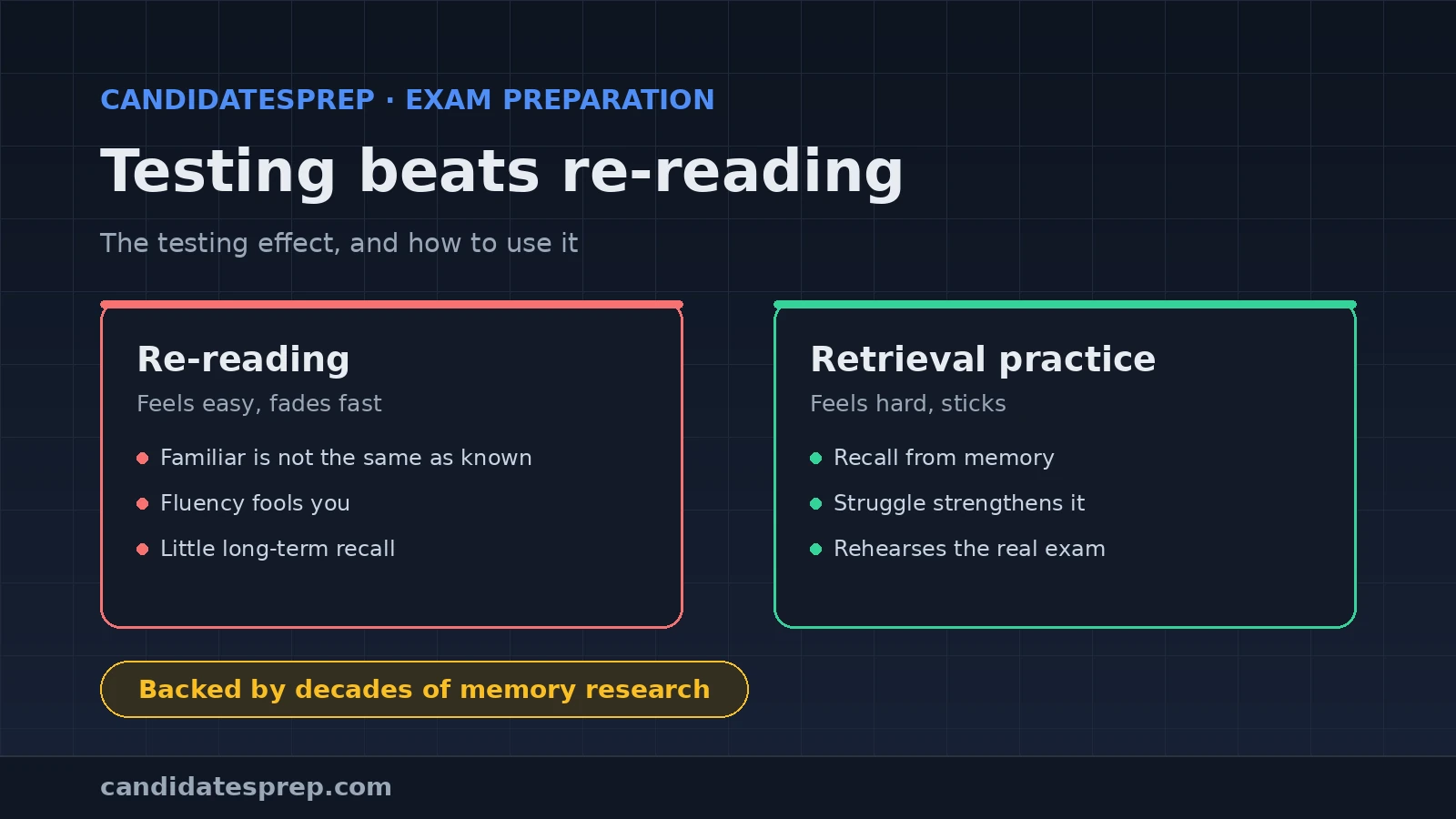
The testing effect, also called retrieval practice, is one of the most robust findings in the science of learning: pulling information out of your memory strengthens it more than putting it back in by re-reading. In a well-known set of experiments, Roediger and Karpicke found that students who were tested on material remembered much more a week later than students who simply studied it again, even though the re-readers felt more confident at the time. The effort of retrieving an answer is what does the work.
Why re-reading fools you
Re-reading is seductive because it feels smooth. The words are familiar, so your brain reads "familiar" as "known". That is fluency, not memory. On exam day the cue is a question you have never seen, not your own highlighted notes, and the familiarity evaporates. Testing removes the illusion early by forcing the exact kind of recall the exam will demand, while you still have time to fix the gaps.
How to use retrieval practice
- Close the book and write down everything you can remember about a topic, then check what you missed. This "brain dump" is retrieval practice at its simplest.
- Turn your notes into questions rather than summaries, and answer them from memory.
- Sit full practice questions and mock exams, which rehearse both the content and the format at once.
- Space it out: revisit a topic after a day, then a few days, then a week. Spacing plus testing beats cramming everything into one session.
Review your wrong answers, not just your score
A practice test you do not review is half wasted. The score tells you where you stand; the wrong answers tell you what to fix. For every question you miss, ask why: you did not know it, you misread it, or you fell for a plausible distractor. Write the correct reasoning in your own words. Over a few weeks, those review notes become a precise map of your weak spots, which is exactly what you should revise last.
Practise under real exam conditions
Flashcards build recall, but they do not rehearse pacing, stamina, or the pressure of a timed paper. Full, timed mocks do all three, and they are retrieval practice by design. CandidatesPrep gives you randomised, timed mocks scored by topic or domain, so every attempt is both practice and a diagnosis of what to revise next. Trainers can set a cohort the same mocks and watch scores climb as retrieval does its work.
The bottom line
Reading is input; remembering is retrieval. Swap some of your reading time for testing time, space it out, and review every mistake. It feels harder than re-reading, and that difficulty is the whole point.
Ready to put it into practice? Start a timed mock on the CandidatesPrep simulator, or book a demo to set retrieval practice for a class. For a specific exam, see guides such as how the IELTS band score works or is there a PMP passing score.