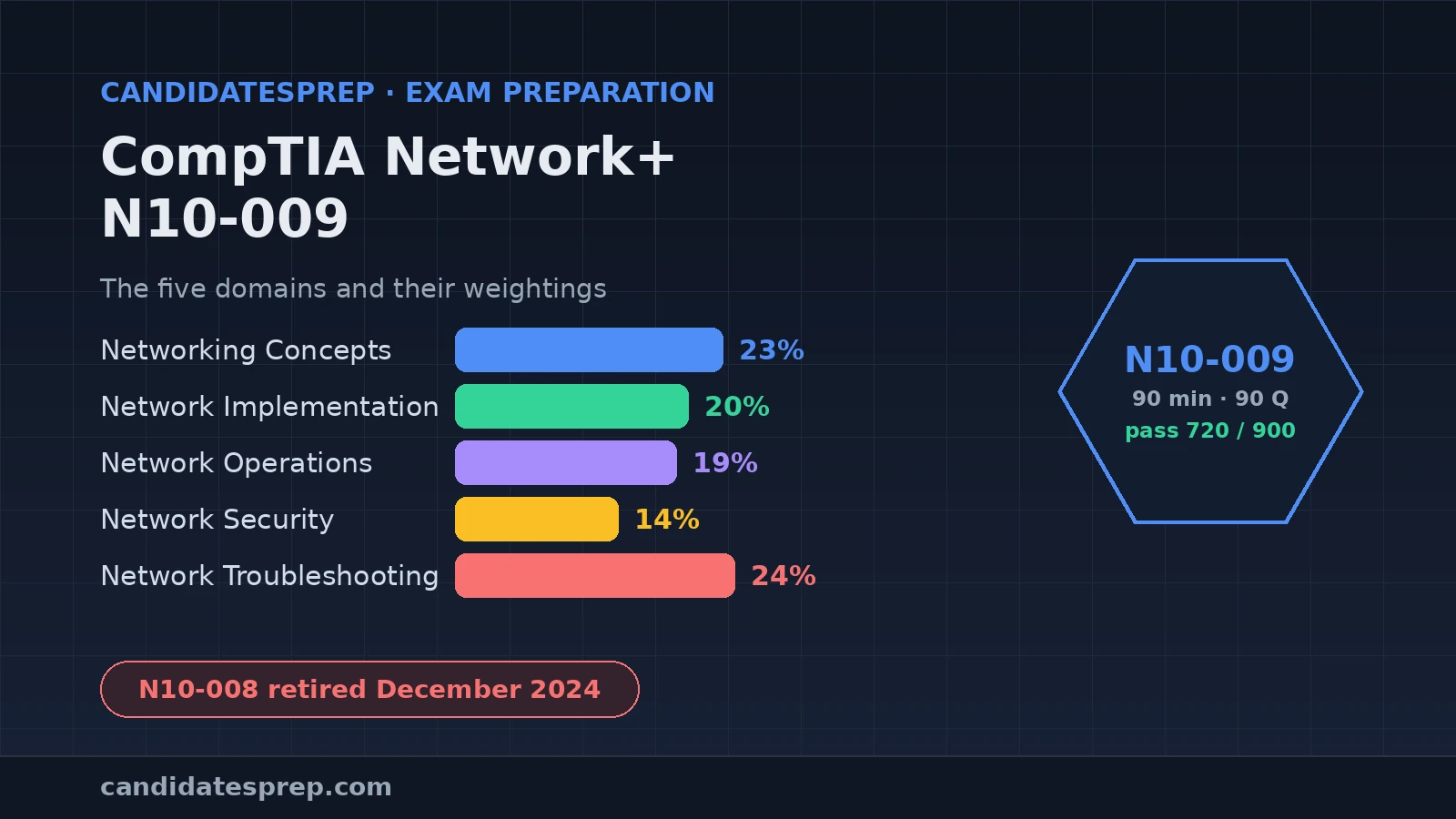
CompTIA Network+ (N10-009) is now the only version of the exam: the previous N10-008 English exam retired in December 2024. It has a maximum of 90 questions in 90 minutes, a passing score of 720 on a scale of 100 to 900, and five domains. Here is exactly what it covers and how to prepare.
What the N10-009 exam tests
The exam is a maximum of 90 questions, a mix of multiple choice and performance-based questions, in 90 minutes. You pass at 720 out of 100 to 900. The five domains and their official weightings are:
- Networking Concepts, 23%
- Network Implementation, 20%
- Network Operations, 19%
- Network Security, 14%
- Network Troubleshooting, 24%
Troubleshooting and networking concepts carry the most weight, so do not treat them as afterthoughts. The retail price is 369 US dollars; check the official CompTIA Network+ page for current pricing and any regional differences. N10-009 launched on 20 June 2024 and, on CompTIA's usual three-year cycle, is expected to run until around 2027.
What changed from N10-008
The five domain names and weightings are stable, but CompTIA refreshed the content toward modern networks. The N10-009 objectives add or expand coverage of software defined networking and SD-WAN, infrastructure as code, VXLAN, IDF and MDF in physical installations, and security concepts including zero-trust architecture and SASE or SSE. If you studied from N10-008 material, download the current objectives and close those gaps before you sit.
How to study for it
Work from the official exam objectives, not a random syllabus. Print them and turn every line into a question you can answer out loud. Weight your time roughly to the domains: troubleshooting and networking concepts together are nearly half the exam.
Learn to think in layers. A large share of Network+ questions, especially in troubleshooting, are really "which OSI layer is this" in disguise. If you can place a symptom at the right layer, you can usually eliminate two wrong answers immediately.
Memorise the essentials cold: common ports and protocols, cable and connector types, IPv4 subnetting, and the wireless standards. These are fast marks and they recur across domains.
Beat the performance-based questions
The performance-based questions (PBQs) are where prepared candidates gain time and unprepared ones lose it. They are scenario tasks: match protocols to ports, configure or read a small topology, or diagnose a fault. They usually appear first, and they are heavier than single multiple-choice items.
Do not let one PBQ swallow ten minutes. If a task will not resolve quickly, note it, move on to the multiple-choice bank where marks come faster, and return with your remaining time. The same discipline that works on Security+ applies here; see our note on handling performance-based questions.
Practise under real exam conditions
Reading about ports and layers is not the same as recalling them under a 90-minute clock with PBQs draining your time. Full, timed mocks that mirror the real interface build both recall and pacing.
CandidatesPrep lets you sit randomised, timed Network+ style mocks scored by domain, so you can see whether it is troubleshooting, security or raw pace holding your score below 720, and retake until it is comfortable. Trainers can set a cohort the same mock and track who is ready to book.
Exam-day tactics
- Triage the PBQs first: do the quick ones, flag the slow ones, and return later.
- Translate troubleshooting questions into an OSI layer before you read the options.
- Watch for "best" and "most likely"; more than one answer will look correct.
- Bank the fast recall marks on ports, cables and subnetting; do not overthink them.
The bottom line
N10-009 is the current and only CompTIA Network+ exam, refreshed for modern networks but still built on the same five domains. Study from the official objectives, drill ports, layers and subnetting until they are automatic, and rehearse the PBQs under time.
Ready to test yourself? Sit a full timed mock on the CandidatesPrep simulator, or book a demo to prepare a whole class for Network+.