Choose PSM I if your work is coaching a team and facilitating Scrum; choose PSPO I if your work is deciding what gets built and maximising a product's value. Both are entry-level Scrum.org assessments built on the same Scrum Guide, and both use an identical exam format, so the real question is which accountability matches your role.
The same exam, two different roles
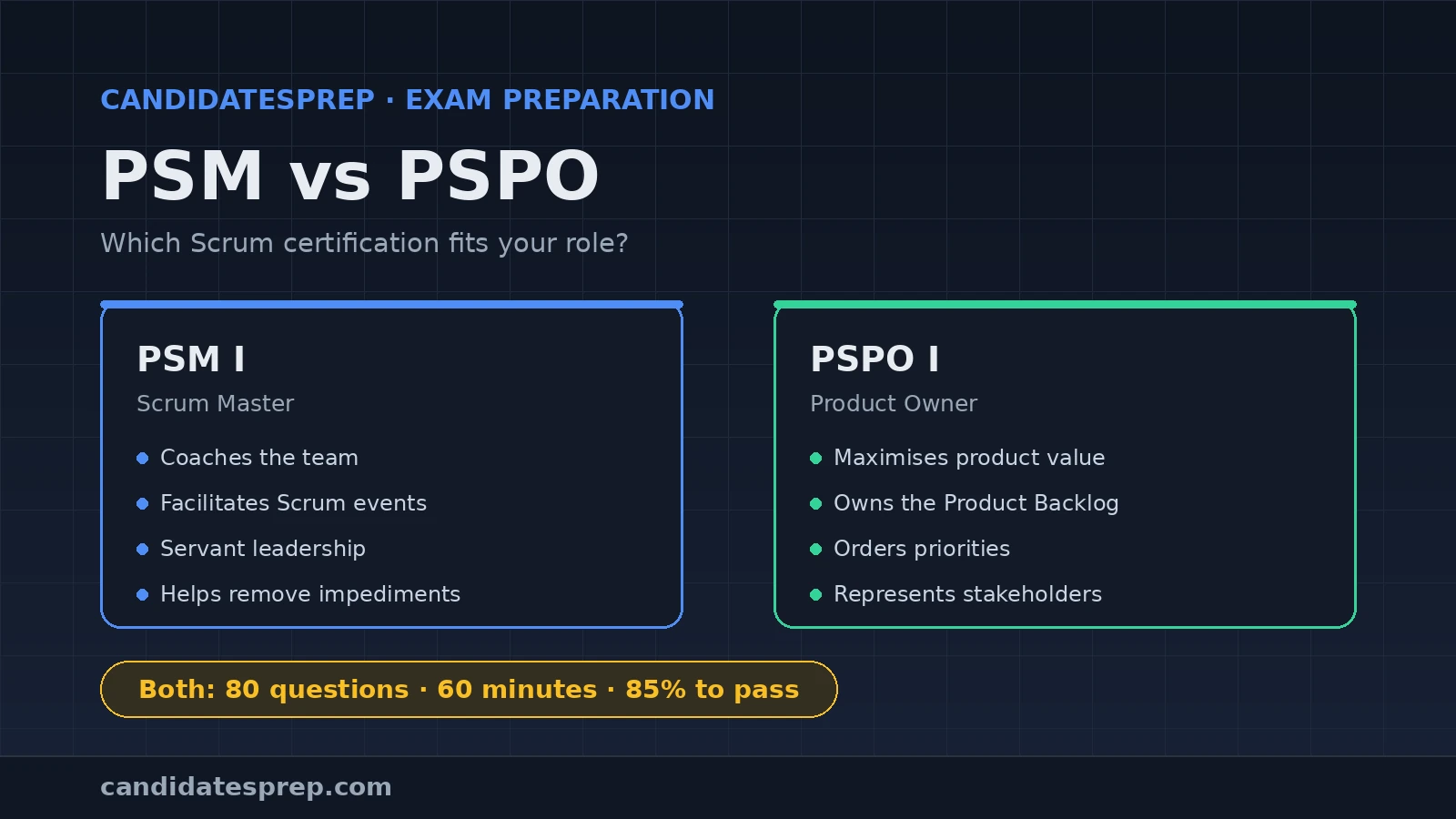
PSM I (Professional Scrum Master I) and PSPO I (Professional Scrum Product Owner I) sit at the foundation level of Scrum.org's certification paths. They share a format: 80 questions in English, a 60-minute time limit, and a passing score of 85%. Questions are multiple choice, multiple answer and true or false. There is no prerequisite and no mandatory course, so anyone can buy an attempt and sit it online from home.
Confirm the current fee and live details on the official PSM I and PSPO I pages before you book. The difference that matters is not how hard the exam feels; it is what each one certifies.
What PSM I tests
PSM I certifies your understanding of the Scrum Master accountability. Expect questions on the Scrum framework itself: the events, the artifacts and their commitments, and the accountabilities within a Scrum Team. On top of that it probes the Scrum Master as a servant leader who coaches the team and the wider organisation, facilitates events without controlling them, helps remove impediments, and improves how the team works.
The Scrum Guide is the primary source of answers. If your instinct is to answer from how your current workplace runs "Scrum", retrain it to answer from the Guide.
What PSPO I tests
PSPO I certifies your understanding of the Product Owner accountability. The focus shifts from facilitating the team to maximising the value of the product: owning and ordering the Product Backlog, making and communicating product decisions, representing stakeholders, and keeping the team pointed at a single, coherent Product Goal.
It still rests on the Scrum Guide, but adds product thinking such as value and stakeholder management. If you can explain why a Product Owner says no far more often than yes, you are thinking along the right lines.
Which should you take
- If you facilitate, coach or run Scrum for a team, take PSM I.
- If you own a product, shape a backlog or decide priorities, take PSPO I.
- If you are new and want the broadest Scrum foundation, PSM I is the more common starting point and pairs well with a later PSPO I.
- Many practitioners eventually hold both, because understanding the other accountability makes you better at your own.
One practical point sets Scrum.org apart from some schemes: these certifications do not expire and carry no renewal fees. If you are weighing the Scrum.org route against the Certified ScrumMaster path, read our PSM vs CSM comparison.
Practise under real exam conditions
Either assessment gives you 60 minutes for 80 questions and demands 85% to pass, which is roughly 45 seconds a question with almost no room to pass on marginal wording. That pace punishes hesitation on definitions you only half-remember.
Full, timed mocks that mirror the real interface build the recall speed and nerve you need. CandidatesPrep lets you sit randomised, timed mocks scored so you can see whether it is the framework, the accountability details or exam pace holding you back, and retake until 85% is comfortable. Trainers preparing a cohort can set everyone the same mock and track who is genuinely ready.
Exam-day tactics
- Read every option in full; "best answer" and "select all that apply" questions punish skimming.
- Anchor answers to the current Scrum Guide, not workplace habits or older Scrum versions.
- Flag and move on; do not lose four minutes on a single wording puzzle.
- Be wary of absolutes like "always" and "never"; Scrum is deliberately lightweight.
The bottom line
PSM I and PSPO I are the same exam shape pointed at two different jobs: coaching the team versus owning the product. Pick the one that matches what you actually do, prepare against the Scrum Guide, and rehearse at exam pace so 85% feels routine.
Ready to test yourself? Sit a full timed mock on the CandidatesPrep simulator, or book a demo to prepare a whole cohort for PSM or PSPO.